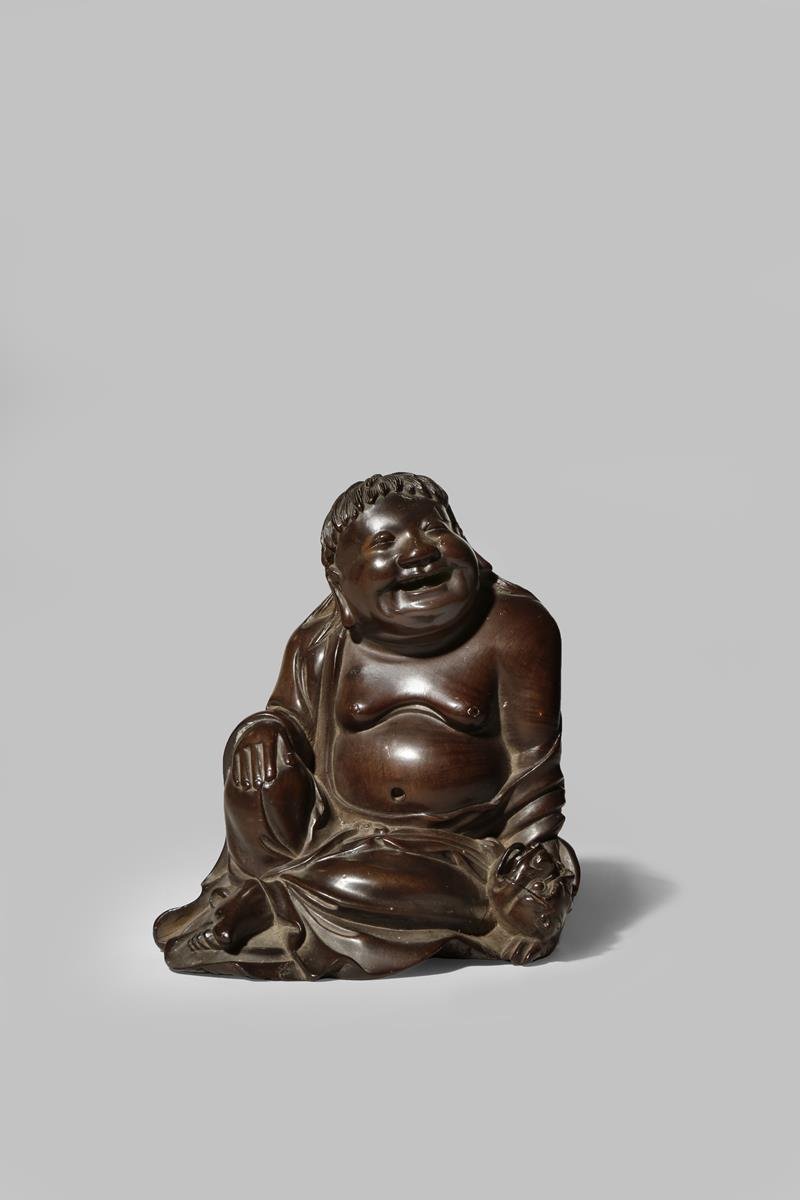
Some carvings impress by scale. This one does the opposite. It is a figure of Liu Hai, the Daoist immortal of wealth, carved in mid-Qing-dynasty China from a dense dark hardwood — possibly zitan — and standing just 12 cm high — an object made for a desk or a counter, to be seen at arm’s length and handled as often as it is looked at.
The subject
Liu Hai — in life Liu Haichan, a 10th-century minister who gave up office for the Daoist path — became one of the most familiar figures in Chinese decorative art: a god of wealth, patron of merchants, and a byword for prosperity invited in.
His companion is the Jin Chan, the three-legged golden toad, and the two belong to one specific story. The toad was a wild, venomous creature that lived at the bottom of a deep well — and it could produce gold coins. Knowing its one weakness, Liu Hai baited a line with a string of cash coins and drew it out: the episode known to every Chinese viewer as “Liu Hai teasing the golden toad” (劉海戲金蟾). Won over, the toad stayed. In the tales it carries the immortal through the air on his journeys, and wherever it appears, wealth follows — coins, in some tellings, spilling from its mouth. That is why the immortal is always laughing, and why the toad is never beyond the reach of his hand.
The pairing became a standing wish in Chinese art — wealth, certainly, but wealth accompanied and content to remain: the image was set on shop counters and merchants’ desks as an invitation to fortune to come in and stay.
The carving
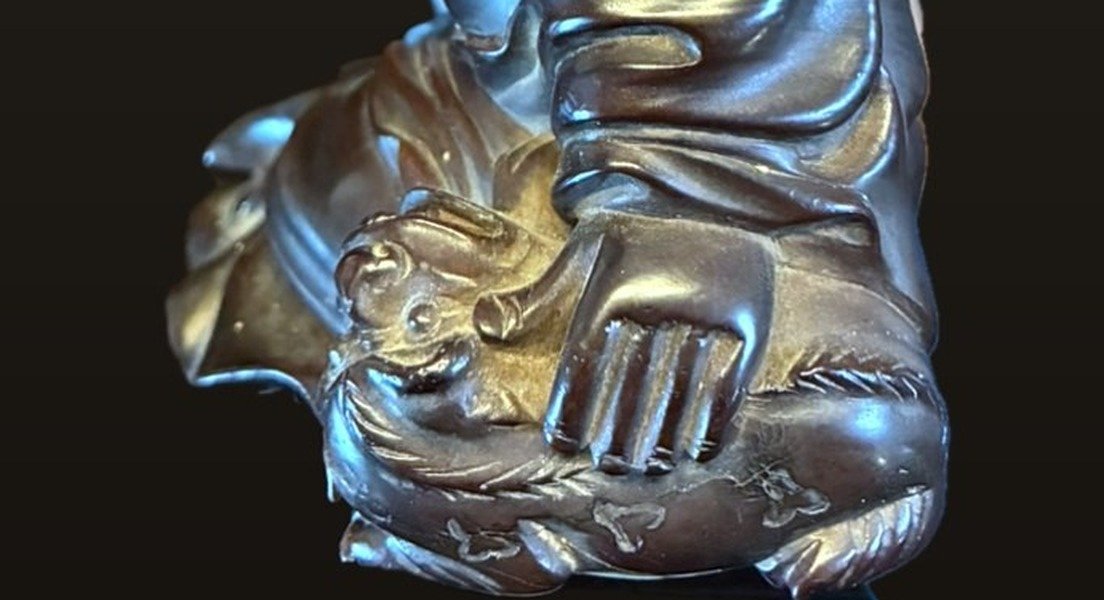
What holds the attention here is the modelling — and above all, the face. Liu Hai is caught in mid-laugh: his head tips back, his mouth opens in a broad, unguarded grin, and his eyes narrow to slits as the cheeks rise. It is an expression of complete, uncomplicated delight, and the carver renders it without tipping into caricature — the mirth stays human. The fringe of hair across his forehead — the feature his name itself evokes — is combed into fine, regular strands; the earlobes hang long; the bare chest and round belly are modelled with the same ease, the flesh soft and unforced. The figure is seated and corpulent, the belly round under robes that fall in deep, unhurried folds — the carver lets the cloth describe the body beneath it rather than decorating the surface. At the figure’s side the toad crouches low, compact and alert, its three legs plainly carved — the detail on which the whole subject turns, and the one most easily missed by a hurried eye.
There are smaller pleasures. At the belly, the carver has cut a navel — an unshowy, anatomical touch that serves no iconographic purpose at all. It is there because the carver was paying attention, and it gives the small figure an unexpected humanity.
The material suits the scale. The wood is a dense, dark hardwood — consistent with zitan, the slow-growing rosewood reserved in the Qing dynasty for imperial furniture and the finest small carvings — and it takes the deep, quiet polish that timber is known for, holding fine detail without splintering. In the hand, a piece like this has a weight that surprises; on the desk, its dark surface absorbs light rather than reflecting it, so the forms read by shadow as much as by line. The attribution to zitan rests on the wood’s
density, colour and grain as handled and examined; we keep the caution the trade itself uses for an untested wood, and catalogue it as possibly zitan. It is a carving that rewards the close looking its size invites.
Dating deserves a word. The figure has previously been catalogued simply as 19th century; in our assessment it is earlier. The wood is thoroughly dried and seasoned with age, its surface settled to a deep, even tone; the carving is bold and economical, its detail reserved for the face and the hands, the drapery left broad and uncluttered; and the taste of the whole — confident, restrained, unshowy — is that of the mature Qing tradition. On the evidence of the wood’s condition, the technique, and the standard of the work, we date the carving to the mid-Qing dynasty, not later than the Daoguang reign (1821–1850). It is a scholar’s desk piece, and at this quality, a genuinely uncommon one.
A note on its recent history
The figure’s earlier history is unrecorded. Its one documented public appearance came on 23 May 2018, when it was offered by Woolley & Wallis in Salisbury, England, in the Asian Art II sale (lot 628). The catalogue described the immortal as seated “with a lion dog to his side” — the toad misnamed — and the lot did not sell. The figure was later acquired online by the present owner and is now in Vancouver, where examination in hand confirmed what the carving itself had said all along: the animal at Liu Hai’s side is his three-legged toad, and the subject is complete.
It is a modest object with a clear lesson. Small carvings of this quality are read, not glanced at — and when they are read carefully, they tend to keep their stories straight.
New works and new research, first
Subscribe and we will email you when a new work is listed or a new Journal article appears. Nothing else — and you can unsubscribe at any time.
