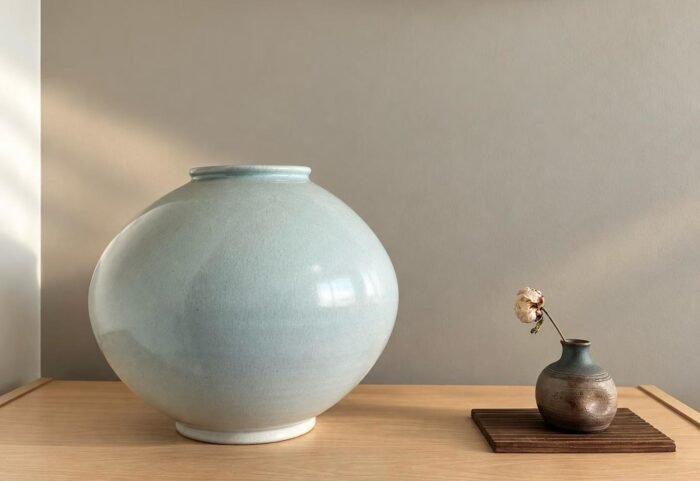
Some works arrive with a name attached. This one arrived with only a shape. When this jar came to ArtValueNow, it was catalogued simply as a Korean white porcelain moon jar: generously proportioned, quietly luminous, and unsigned in any way a casual glance could read. It took a closer look, a single character, and a chain of comparisons to give it back its maker. This is the story of that identification, and of the potter it led us to: Ahn Dong-oh (安東五, 1919–1989).
The moon jar, or dalhangari, is one of Korea’s most beloved ceramic forms. It is made by throwing two hemispherical bowls and joining them at their widest point, so that the finished vessel swells like a full moon. The classic examples date to the Joseon dynasty of the seventeenth and eighteenth centuries, when white porcelain became the ware of the court and the scholar’s studio. Twentieth-century potters revived the form, and the finest of them understood that its power lies in restraint: a milky white glaze, a soft, slightly irregular silhouette, and a surface that rewards slow looking. The jar in question stands 24 centimetres high and measures 32 centimetres across its belly. It has that quiet presence in full.
For a long time, the jar had no name attached to it at all. Its glaze, its weight, and its proportions all said “Korean moon jar,” but they did not say whose. The answer, when it came, was underneath: at the centre of the base, painted in underglaze blue, a single character — 安. One character is the hardest kind of clue. A full reign mark or a studio inscription can be looked up in a reference book. A lone character might be a surname, a place, a studio name, or a wish — in this case, the character An, meaning peace. There was no other inscription and no paper trail, so the mark itself had to carry the whole investigation.
Attribution work is mostly comparison. We studied the character itself — its proportions, the weight and confidence of its strokes — and set it beside the jar’s other evidence: the tone of the glaze, the shape of the foot, and the way the two halves meet. The decisive comparison came from a marked work published by Dai Ichi Arts: the same single character, written in the same hand, on a jar of the same ware and character. When a mark, a material, and a form all point the same way, an attribution stops being a guess. The maker was Ahn Dong-oh.
Ahn Dong-oh (1919–1989), who worked under the art name Hosan, came to ceramics by an unusual route. In the late 1950s, he immersed himself in the traditional craft through the appraisal and restoration of old ceramics — learning how the great wares were made by handling, mending, and studying them. Around 1962, he established his own workshop in Gwangju, Gyeonggi Province, and began to make the works for which he is remembered. The moon jar became his signature form, but his range was wide: blue-and-white porcelain, copper-red ware, relief decoration, and openwork carving all came from his kiln.
His standing is recorded in museum collections. His works are held by the National Museum of Modern and Contemporary Art, Korea, and by the Museum of Far Eastern Antiquities in Sweden, and the British Museum holds a porcelain vase with a peony scroll design that he donated, made in about 1986. That a potter who learned by restoring the past should have his own work collected in its turn is a fitting symmetry — and it explains why his moon jars, when they appear, are watched closely by collectors of Korean ceramics.
Why does a single character matter so much? Because attribution changes everything around an object. An anonymous jar is a beautiful thing; a jar by Ahn Dong-oh is a documented work with a place in a known career, a comparable body of work, and a market of collectors who understand what they are looking at. It affects how the piece is valued, how it is described, and how confidently a buyer can live with it. That is why research comes before offering at ArtValueNow: every work we sell is investigated before it is priced, and every attribution we publish is one we are prepared to defend.
For collectors, the lesson is practical. When you pick up a moon jar, turn it over. The base often carries the only written evidence you will ever get: a character, a workshop mark, or nothing at all. Photograph it in raking light, note the colour of the glaze where it pools near the foot, and compare the form against published examples before you settle on a name. Marks can be faked and attributions can be optimistic, which is why a single comparison is never enough — the mark, the clay, the glaze, and the shape all have to agree.
The jar that started this story is now available from ArtValueNow — a moon jar that waited, nameless, until a single blue character gave it back its maker. And if you own a piece with a mark you cannot read, or no mark at all, that is exactly the kind of puzzle we like. Submit your artwork for a confidential review, or talk to us about buying and selling: the research is part of the service.