Toyohara Kunichika (1835–1900)
Koi no Minato Hakata no Hitofushi (“A Hakata Ballad of the Harbour of Love”)
Published August 1883 (Meiji 16) · Ōban nishiki-e triptych · Colour woodblock print
Publisher: Yamamura Kōjirō, Tokyo · Carver: Gin
Presented in a modern frame with a deep-blue mount
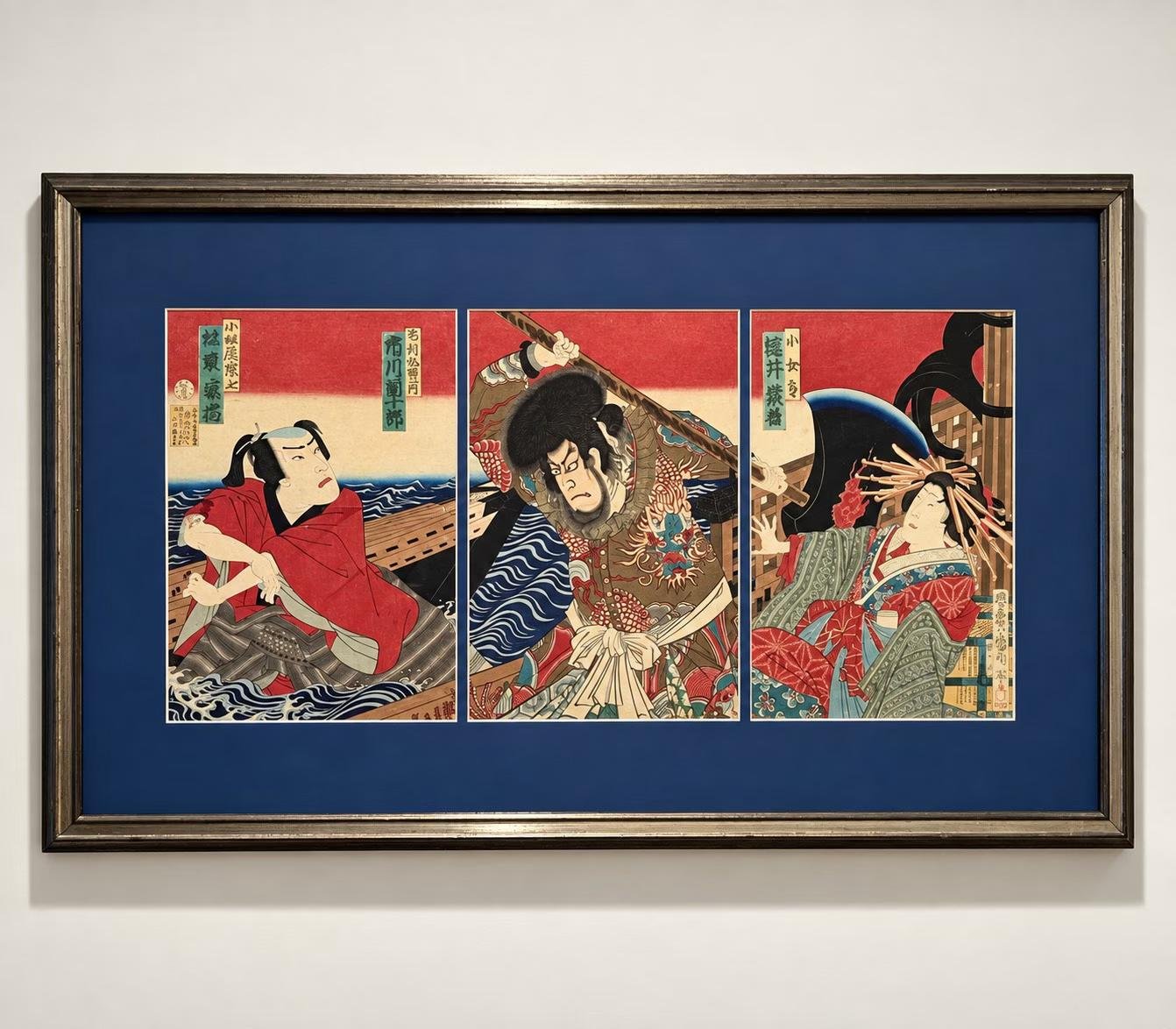
The first thing to see in this triptych is that it is one picture, not three. Join the sheets and the composition runs straight through the joins: the band of saturated red sky is unbroken across all three, the sea horizon and the decks of the boats carry through, and even the central figure’s weapon ignores the sheet divisions — the long haft of Kezori Kuemon’s axe enters from the centre sheet and its great black blade hangs in the right-hand sheet, above the courtesan’s head. Kunichika composed for the joined triptych.
At left, the merchant Komatsuya Sōshichi — played by Bandō Kakitsu I — recoils on deck in a red kimono and grey wave-patterned hakama, arms folded in defence, the sea already splashing at the gunwale. At centre, the pirate chief Kezori Kuemon, played by Ichikawa Danjūrō IX — the defining actor of Meiji kabuki, revered after his death as the “Saint of the Theatre” — fills his sheet: wild black hair, a Chinese dragon robe that nods to the China of the Coxinga story, and both hands on the haft of a great axe swung high, its black fan-shaped blade edged in steel blue along its upper curve; his glare is aimed across the join, at Sōshichi. At right, the Hakata courtesan Onna-rō, played by Iwai Shijaku IV, shrinks back beneath the blade, her hair a blaze of gold ornaments, one hand raised; behind her rise the wooden storehouses of the harbour, drawn in brown lattice.
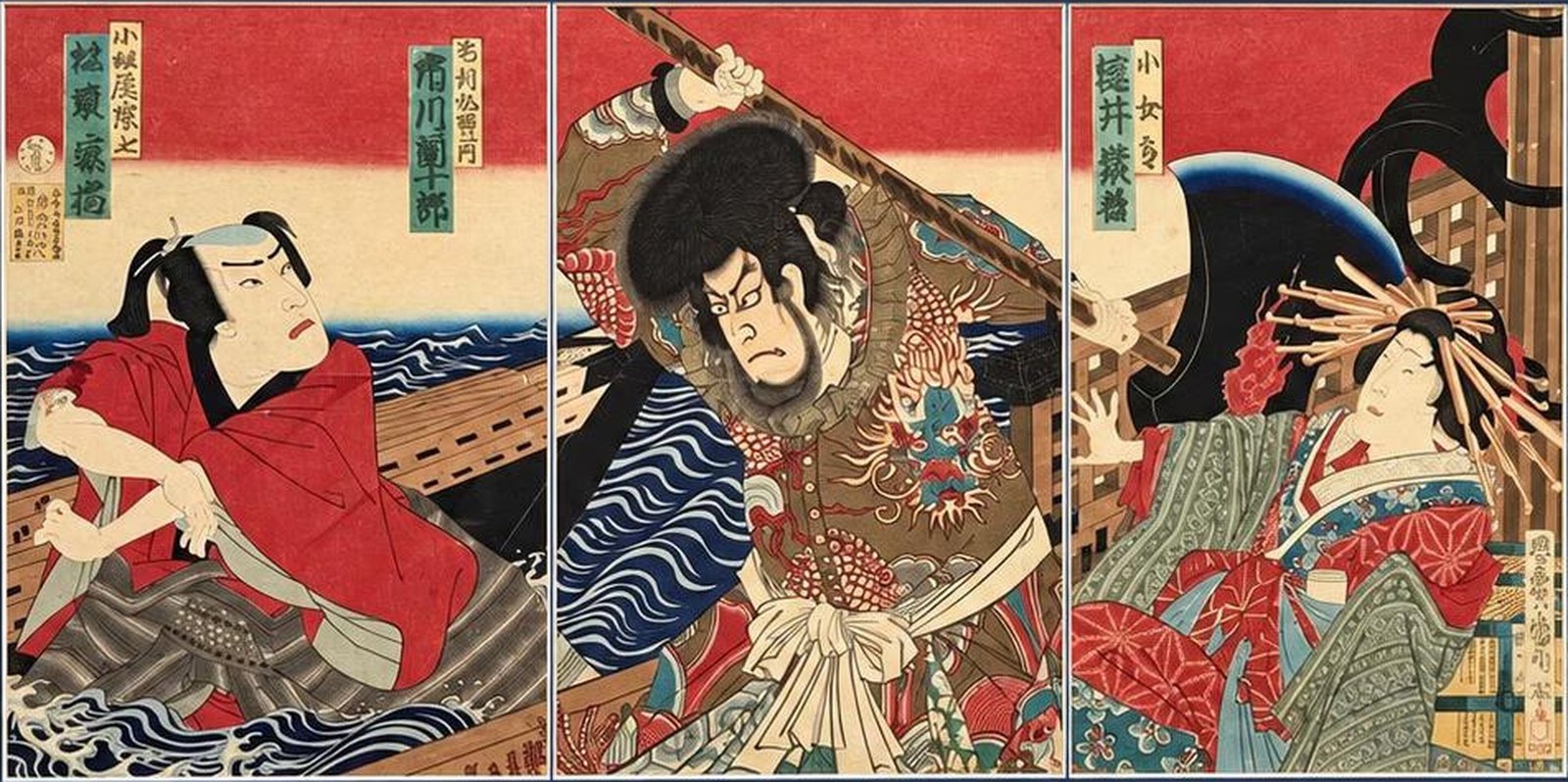
The colour is Meiji nishiki-e at full strength: the flat red of the sky, graded at its lower edge in bokashi; deep indigo waves crested with white; the saturated reds of the two robes answering each other across the composition. The sheets were published by Yamamura Kōjirō of Tokyo in August 1883, the carving credited to the carver Gin.
The print records a specific night at the theatre: Kokusen’ya Kassen (The Battles of Coxinga, in the lineage of Chikamatsu Monzaemon’s celebrated play) at the Shintomi-za, Tokyo, on 21 August 1883. In the story, Sōshichi boards a smuggling vessel by mistake and discovers its captain’s secret; Kezori moves to silence him, and the two men are drawn into a rivalry over Onna-rō. The triptych takes the confrontation at its height — the instant before the axe falls.
Collections and references
An impression of this same edition is held by the Tokyo Metropolitan Library (Tokyo Shiryō collection, call no. M348-43-1), whose TOKYO Archive database records the print’s full publication and performance details: Tokyo Metropolitan Library record. Kunichika’s actor prints are also held by major collections including the Ōta Memorial Museum of Art, Tokyo, the Graphic Arts Collection at Princeton University, and the Lavenberg Collection of Japanese Prints.
The artist
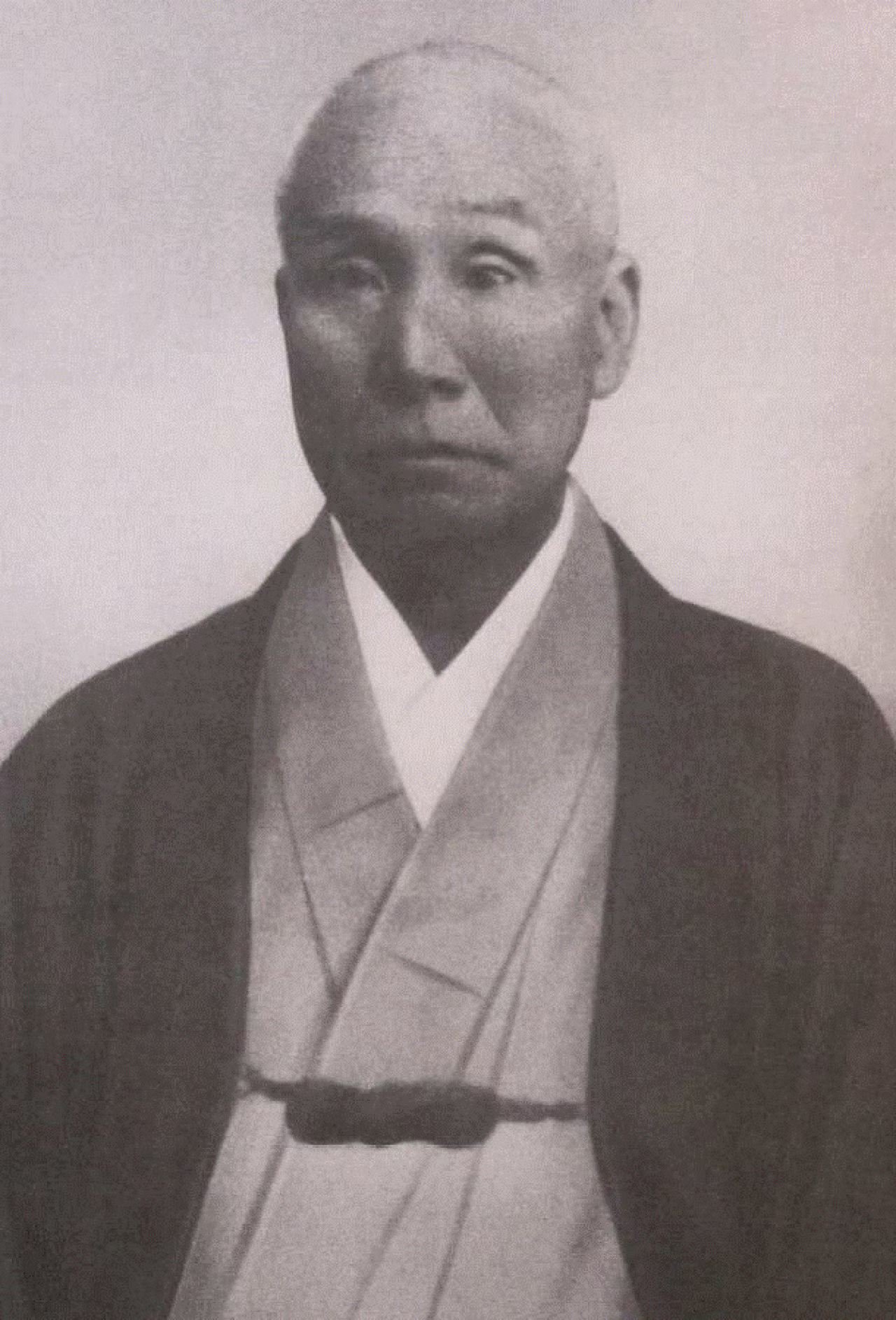
The artist who signs these sheets, Toyohara Kunichika (1835–1900), was the great chronicler of the Meiji stage. Born in Edo’s Kyōbashi district, he studied first under Toyohara Chikanobu — from whom he took the surname Toyohara — and then under Utagawa Kunisada (Toyokuni III), joining the “Kuni” of Kunisada to the “Chika” of Chikanobu in his art name. Praised as the “Sharaku of Meiji” and ranked with Tsukioka Yoshitoshi and Kobayashi Kiyochika among the three great ukiyo-e artists of the era, he made the actor print his life’s work; Danjūrō IX, the centre figure here, was his great subject, portrayed by him in role after role, in his final years across a series of one hundred portraits.
A collector’s note
“Deeds, not words. In Japan I looked at ukiyo-e in quantity, and it was Kuniyoshi’s warrior prints that showed the real mastery. After years of collecting, the test for keeping a piece has become a simple one: if you love a thing, it should keep you company for a long time — it has to bear being looked at every day. This Kunichika triptych passes that test. Printed in 1883, when Meiji nishiki-e colour was at its richest; Danjūrō IX at the centre in his dragon robe, axe held high — Kunichika’s actor prints at their most commanding; the three sheets complete, and the edition on record at the Tokyo Metropolitan Library. It is the first set of ukiyo-e I ever bought, and since it went on the wall, it has never occurred to me to take it down.”
—— Aaron Hao
