Some paintings arrive with their history attached; others have to be given it back. This small oil on panel — a young woman in period dress, holding roses in a garden, signed lower left “E. BARÉ.” — came to us as an unrecorded work by the French painter Émile Baré (1851–1930). No auction record anywhere matches it. What follows is the research we carried out before offering it: the physical evidence of the panel itself, the Toronto gallery label on its frame, and a census of the artist’s recorded works against which this picture was checked, one by one.
The painting
A young woman stands full-length in a garden, head lowered, a single rose in her right hand and a gathered bunch of roses against her chest. She wears a white ruff collar, a cream satin bodice and overskirt with lace cuffs, and a long blue skirt trimmed with lace and a floral garland at the hem. To her right, a classical stone urn on a pedestal is draped with flowering vines; rose bushes in pink bloom flank her on both sides. The subject belongs to the artist’s garden and flower group — garden settings with a single female figure and flowers — and the stone urn recurs in his Tuileries garden scenes. The panel corresponds to the French standard size No. 4 Figure (33 × 24 cm); the work itself measures approximately 32 × 24 cm within its frame.
The signature
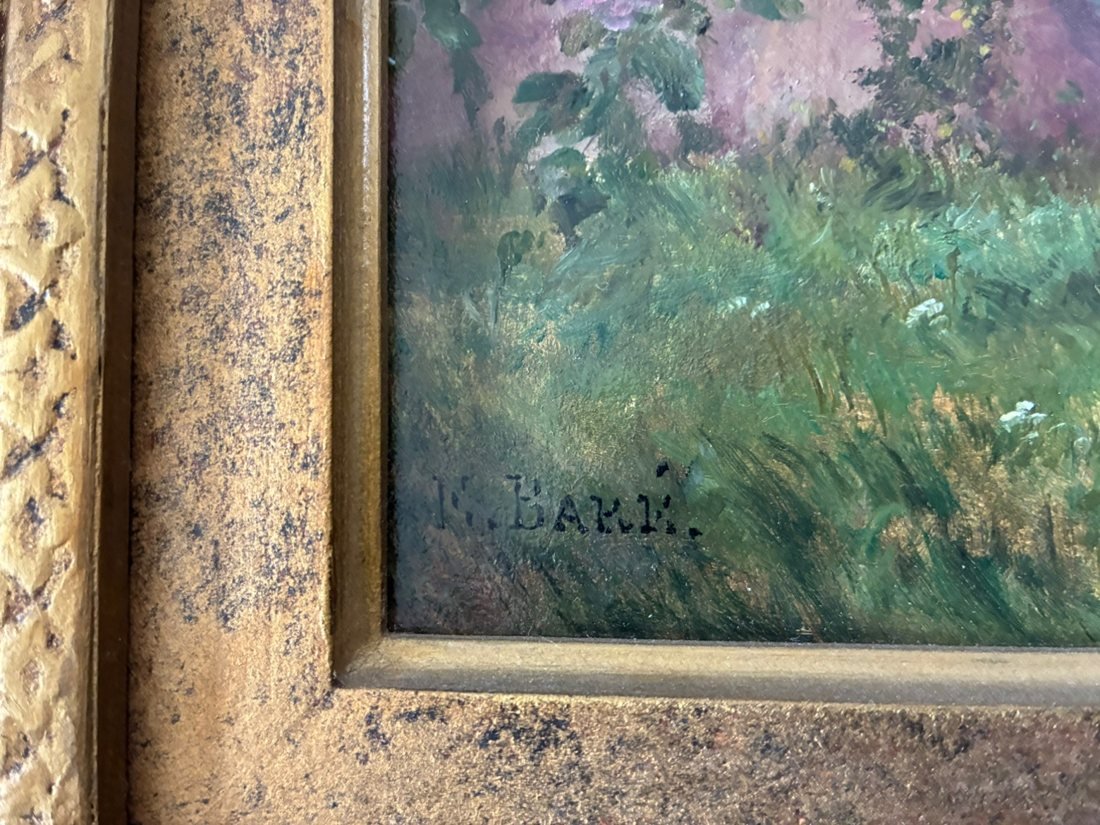
The signature, lower left on the grass, reads E. BARÉ. in fine block capitals, the É carrying its acute accent and a full stop closing the name. In high-resolution detail the strokes are matte and are interrupted by the same age craquelure and wear as the surrounding paint: the signature has aged with the picture. Its form is identical to the signature on the Tuileries Gardens by the same hand in the Clark Art Institute — an unusual all-capitals form that distinguishes this painter from the Belgian artist Émile de Baré de Comogne, whose signature and landscape subjects are entirely different.
The verso, and a Toronto chapter
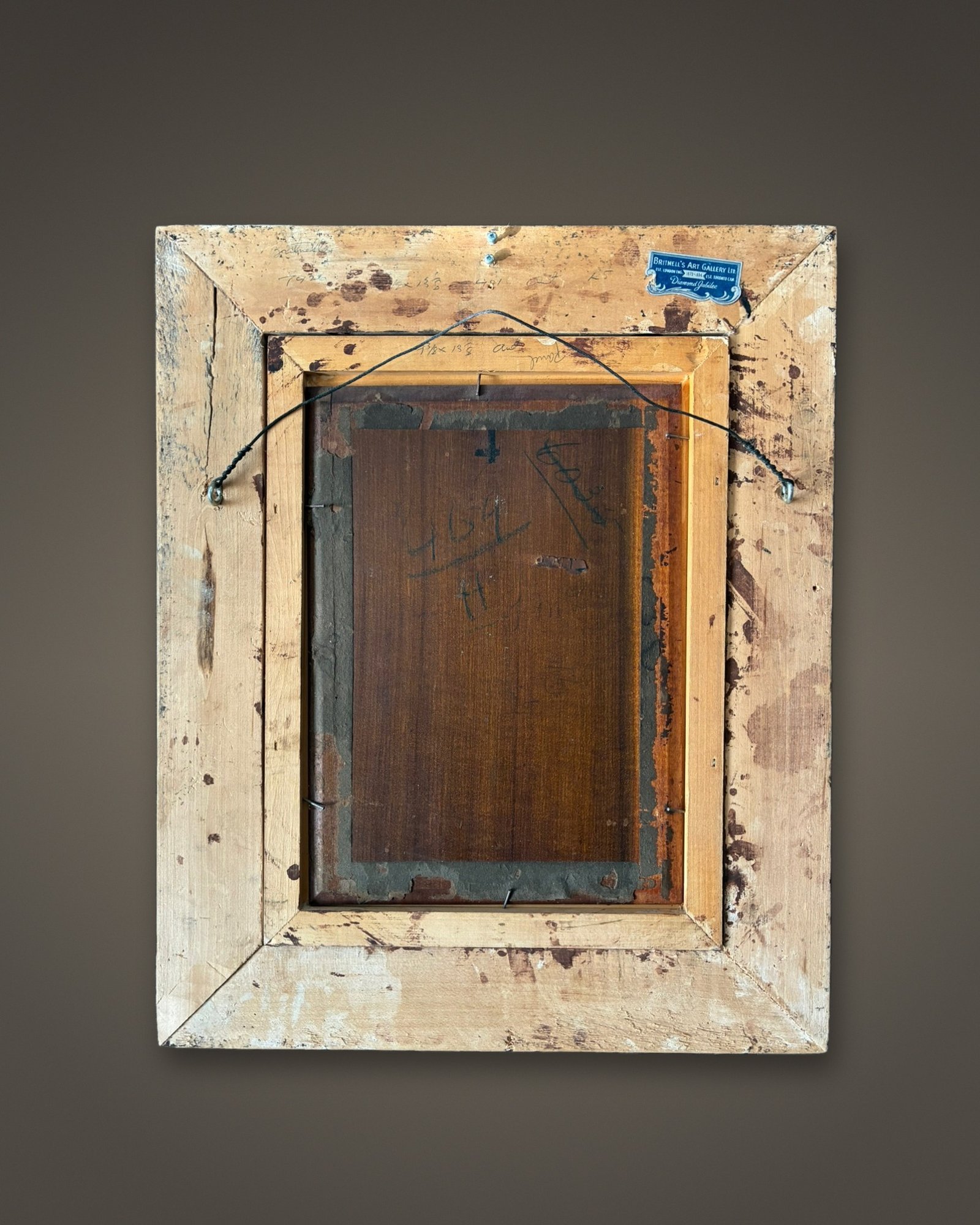
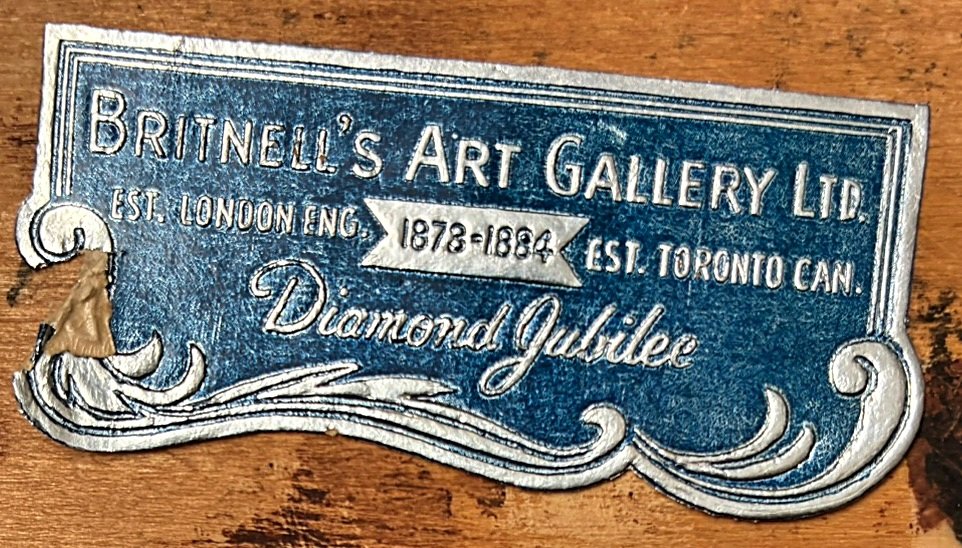
The support is a single panel of dark hardwood. Its verso carries the large stock notations “464” and “14” — the marks of at least one passage through a dealer’s hands before the picture was framed. The frame’s label is that of Britnell’s Art Gallery Ltd. of Toronto, in its “Diamond Jubilee” issue: the banner’s dates read as the gallery’s two foundings, London in 1878 and Toronto in 1884, which places this jubilee label — and Britnell’s handling and framing of the picture — in the late 1930s to 1940s, or shortly after. The frame’s pencil inscriptions (the gallery’s numbers 7932 and 481, and the dimensions) complete the picture of a work that was in Toronto by that period.
Provenance
The chain, so far as it can presently be documented, runs: painted in France, 19th century (early history unrecorded); dealer stock notations on the panel verso; Britnell’s Art Gallery Ltd., Toronto, by the late 1930s–1940s (label and framing); a private collection in Eastern Canada, according to the vendor; acquired by the present owner in Vancouver in October 2025.
Checked against the record
In October 2026 we reconstructed more than 33 auction and listing records under the names Emil Baré, Emile Baré and E. Baré, cross-checked against the artist’s pages on the principal art-market databases and sale archives. The present painting matches none of them: it is an unrecorded work, and its documented history runs through the gallery trade rather than the auction room — which is precisely why no auction record exists. Two near-misses deserve naming. The picture sold at Christie’s in 1993 as “An elegant Lady before a Waterlily Pond” and again at Christie’s South Kensington in 1994 as “A Summer Rose” is one and the same different work — signed and dated 1873, lower right, a waterlily-pond subject. The “Parisian Flower Vendor” sold at Christie’s East, New York, in 1995 is likewise a different, landscape-format panel. All other records are excluded by image, subject, or dimensions.
Condition, as far as photographs show
As seen in the photographs published here: the paint surface is well preserved, the colour fresh, and the craquelure consistent with the picture’s age. There is a small damage spot on the panel verso which does not affect the image. The frame is a later ornate gilt frame, consistent with the Britnell framing, with age-consistent wear. No ultraviolet or technical examination has been undertaken; the full provenance dossier, with all plates, is available on request.
The painting is now offered by ArtValueNow: Émile Baré — Young Woman with Roses in a Garden, Oil on Panel. Questions — including requests for the full dossier — are welcome at artvaluenow@gmail.com.
New works and new research, first
Subscribe and we will email you when a new work is listed or a new Journal article appears. Nothing else — and you can unsubscribe at any time.
