This is a Japanese carved-bamboo brush pot. Around its body, in high relief, unfolds the Battle of the Monkey and the Crab: monkey and crab face each other down, while a small monkey sits curled to one side, watching. Set into the wooden base beneath is a plaque signed Kakuho saku — “made by Kakuho.” We date the pot to the Meiji period. But who was Kakuho? This article follows two leads — a netsuke carver named Kakuho of Gifu, and Inoue Kakuhō, a shrine carpenter of Okayama — without, as yet, being able to settle the maker’s identity. The tale of the Monkey and the Crab, for its part, has its own history of transmission, from folktale to elementary-school textbook; and the fur, and the spirit, carved into this bamboo repay a close look.
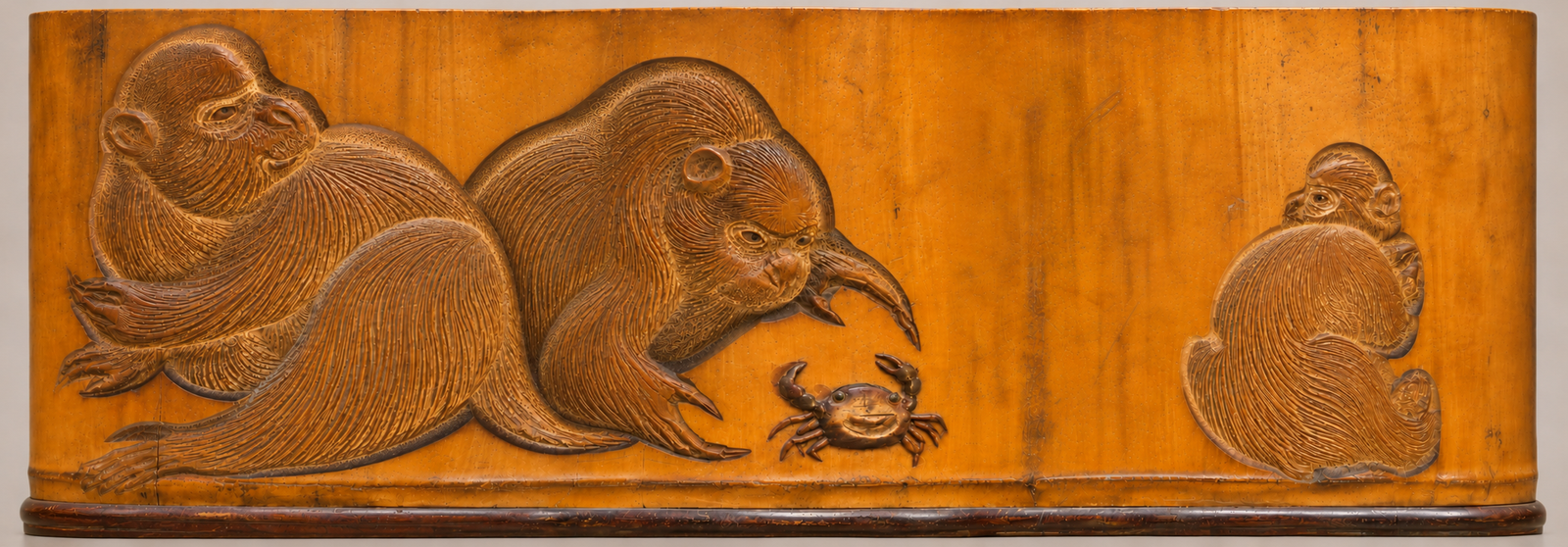
What catches the eye first is the fur, rendered to the very last hair.
Across the bamboo, thousands of fine lines turn with the muscle, dividing light and shade over the curving surface. Line upon line: where they crowd, they make shadow; where the surface rises, they catch the light.
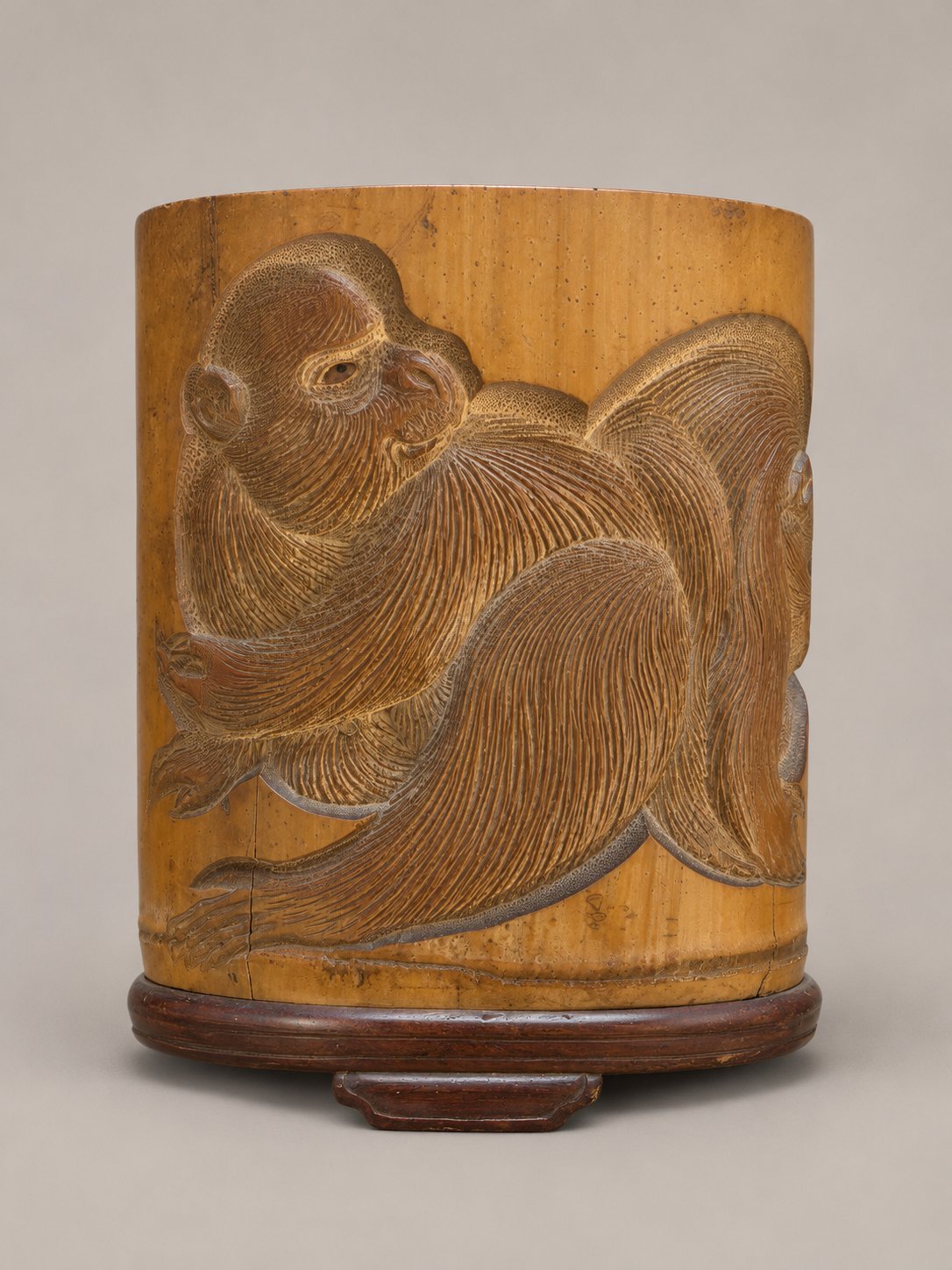
Three Monkeys, Three Reactions
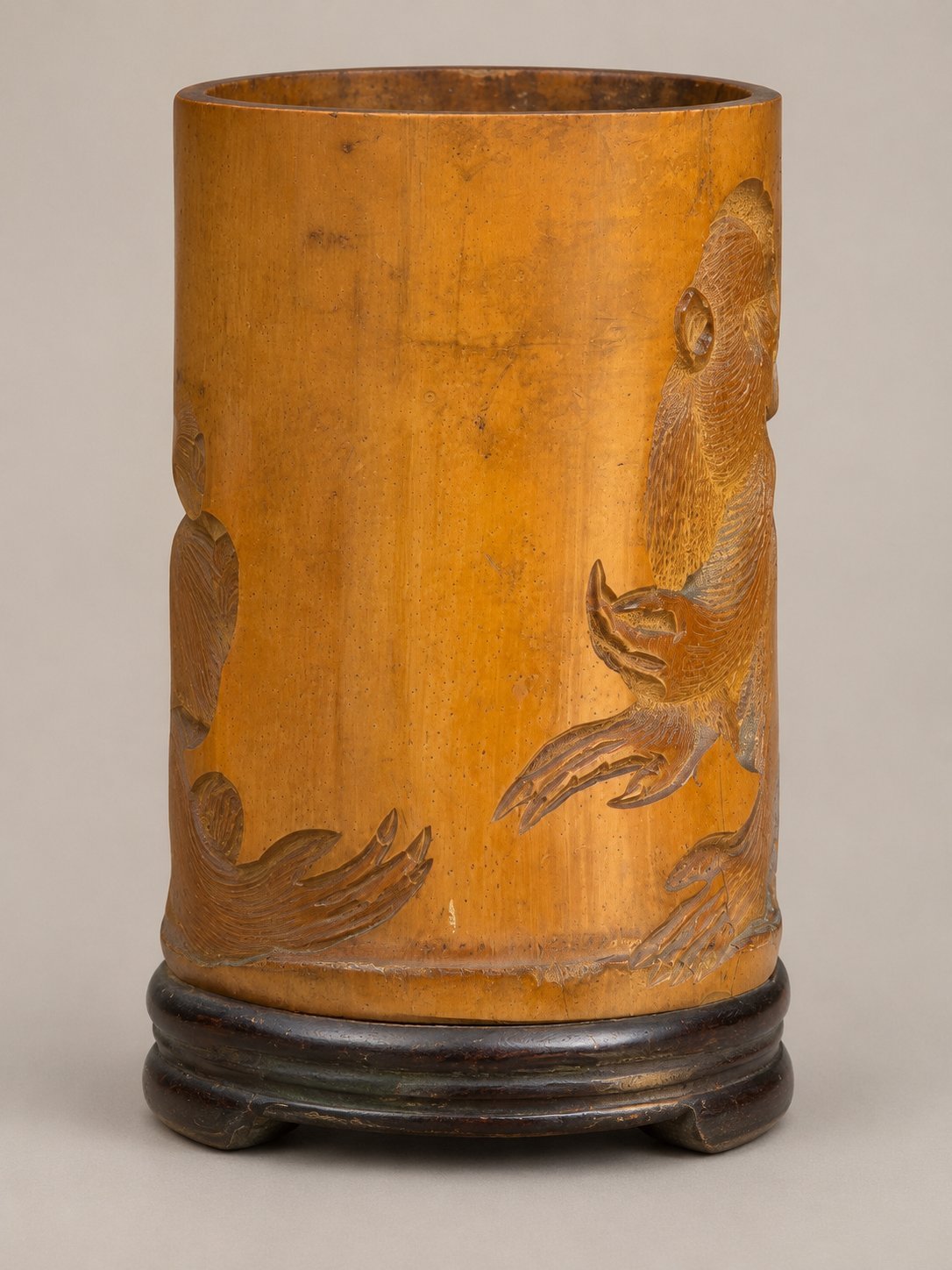
Begin with the two monkeys nestled together, and turn the pot slowly: the family comes gradually into view. The mother sits, turning her head toward her neighbour; the male leans forward, paw outstretched, facing a small crab — and the crab raises its claws and will not yield an inch. Turn further, and on the other side a third, small monkey sits curled and trembling, watching from the sidelines.
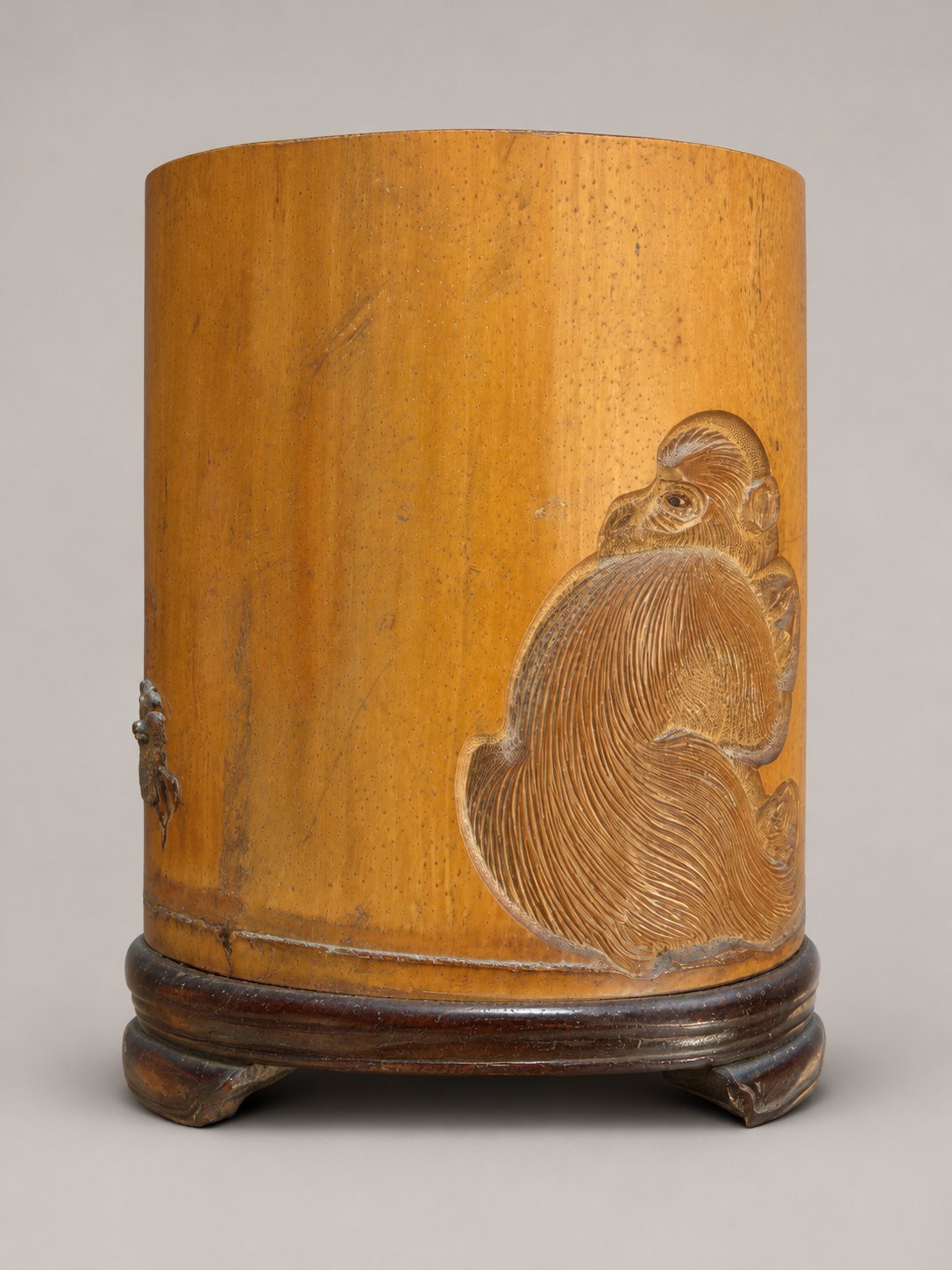
The carving’s subject is Saru Kani Gassen (さるかに合戦) — “The Battle of the Monkey and the Crab” — a tale of revenge, a fable, widely told across Japan.
The story goes like this: the monkey trades a persimmon seed for the crab’s rice ball. The crab plants the seed; the tree bears fruit; but the crab cannot climb, and must ask the monkey to pick the persimmons for him. The monkey eats the ripe fruit himself, and throws the unripe ones down.
In some versions, the father crab is killed, and the young crab returns with allies — a chestnut, a bee, a mortar — to take revenge. In others, the father crab is hurt, and in the end punishment is dealt out in gentler form, and the parties are reconciled.
Folklore scholarship reads the tale as a compound structure: the first half turns on an unfair exchange of food; the second, on the weak banding together to punish the strong. Some regional tellings keep only the first half. [1]
By the Edo period, this tale of rebellious revenge had long since entered picture books and painting.
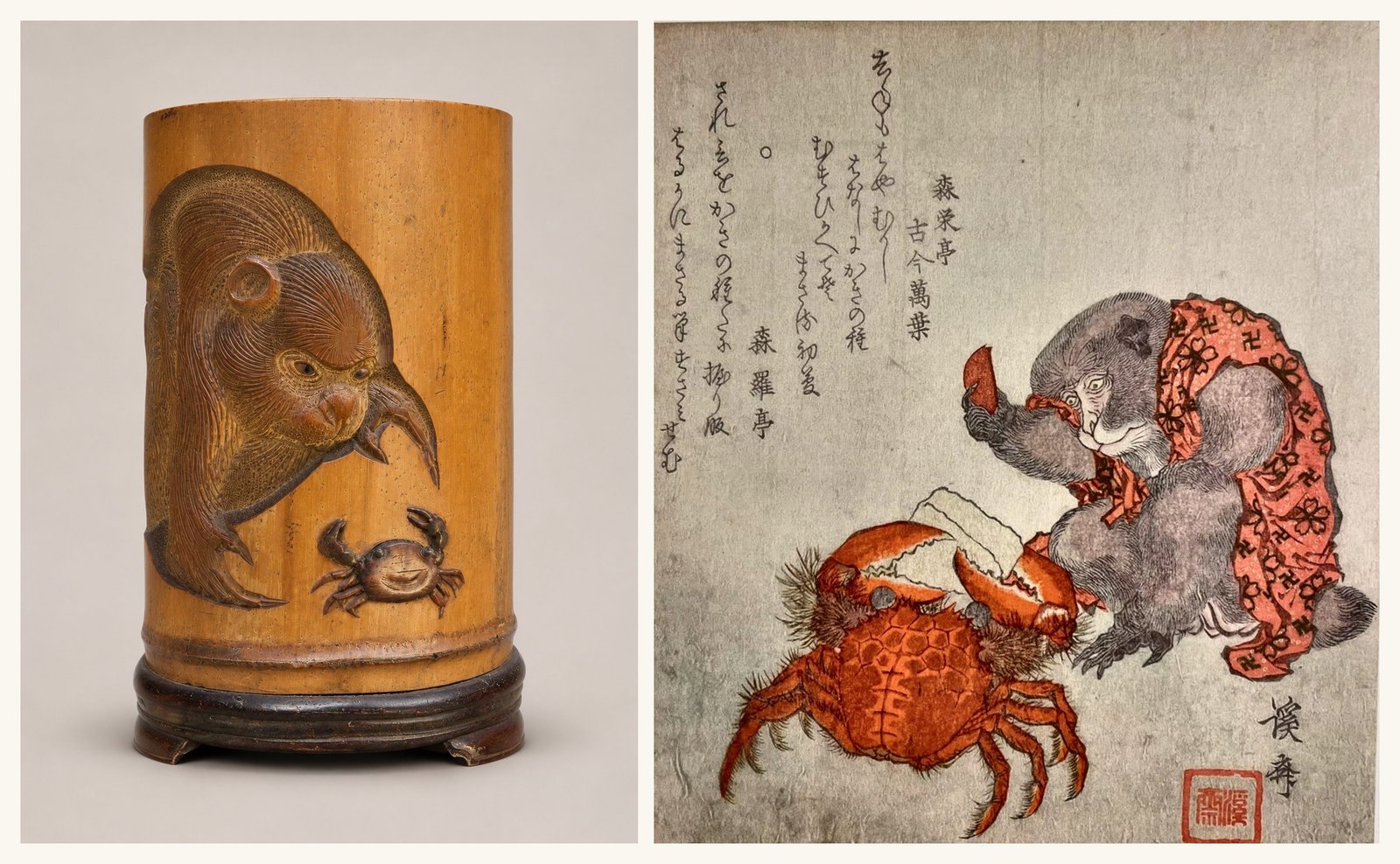
It went on being retold. In 1885 the third number of the Japanese Fairy Tale Series carried David Thompson’s English translation; in 1887 the tale entered the second volume of the Ministry of Education’s elementary reader as “The Story of the Monkey and the Crab”; in 1903 Andrew Lang included it in The Crimson Fairy Book; and in 1923 Akutagawa Ryūnosuke wrote a biting short sequel under the same title. [2–6]
Beneath the comedy sit deception, strength and repayment. Strength and cunning let the monkey profit — but they do not guarantee he will profit for long. The weak, together, can change the outcome.
This pot does not carve the whole story. There is no persimmon tree, no rice ball, none of the avengers — only the posture of monkey and crab, neither willing to yield. The carver took the very climax of the conflict out of the tale, and let it settle into a family of monkeys, each lost in its own thoughts.
A Thousand Lines of Fur, Two Points of Light
Against the monkey’s thousand lines, the crab receives almost nothing: a round shell, two claws, and two eyes.
On handling, those eyes prove to be small inlaid metal pins. Their heads catch a point of light as the pot turns, so that the smallest actor in the scene seems the most alert.
The device is especially telling. The crab’s body is small and its movement limited, but two points of light lift its whole spirit. Facing an opponent many times its size, it does not look inclined to step aside.
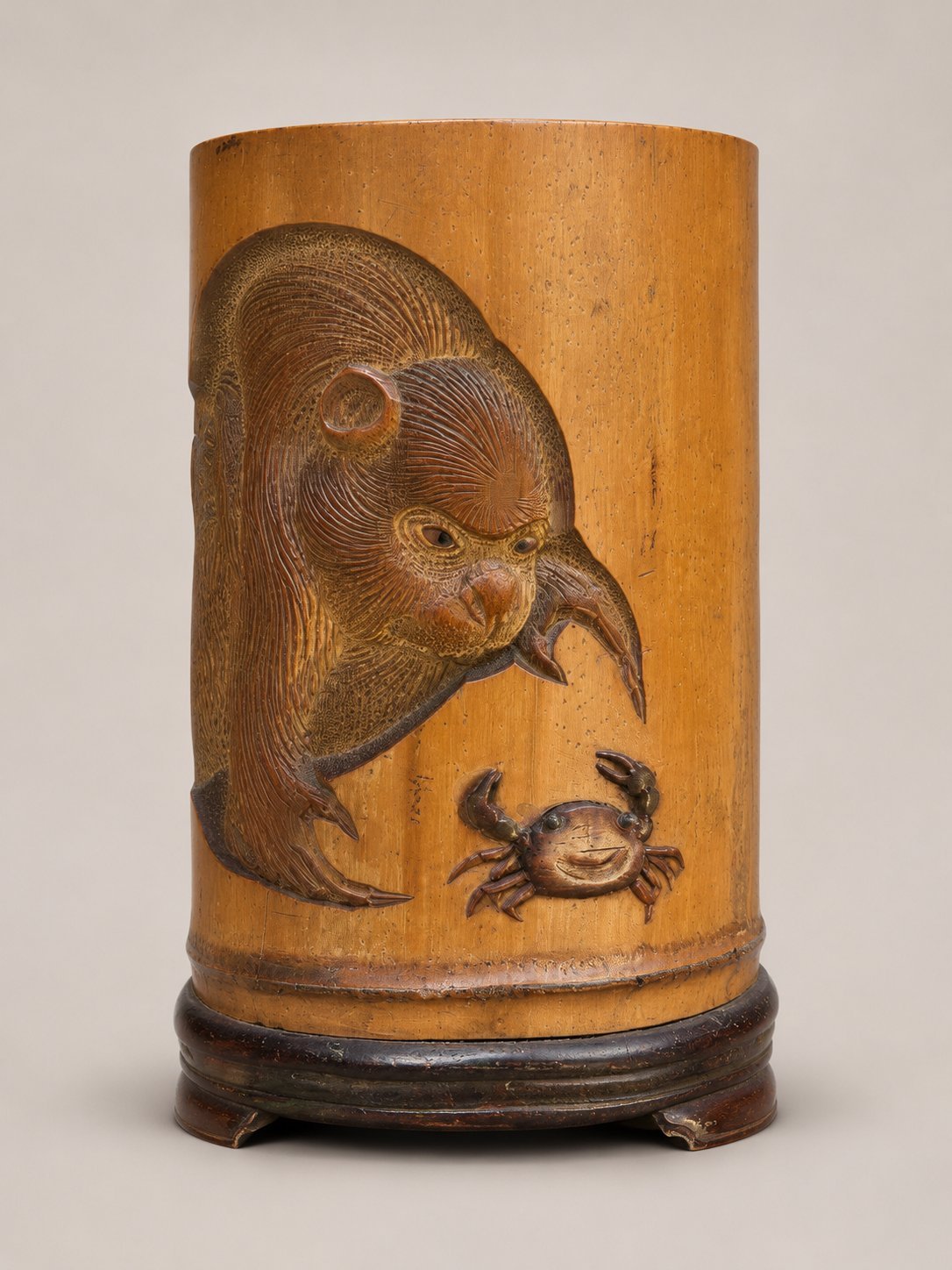
The monkeys’ fur builds life another way. The fine lines turn with the muscle, and every group of lines obeys — beautifully — the structure of the body.
Abundance and economy each find their place: the monkeys, magnificent in acres of fur; the crab, eyes glaring, not retreating a hair’s breadth.
Bamboo and Base: What the Years Have Left
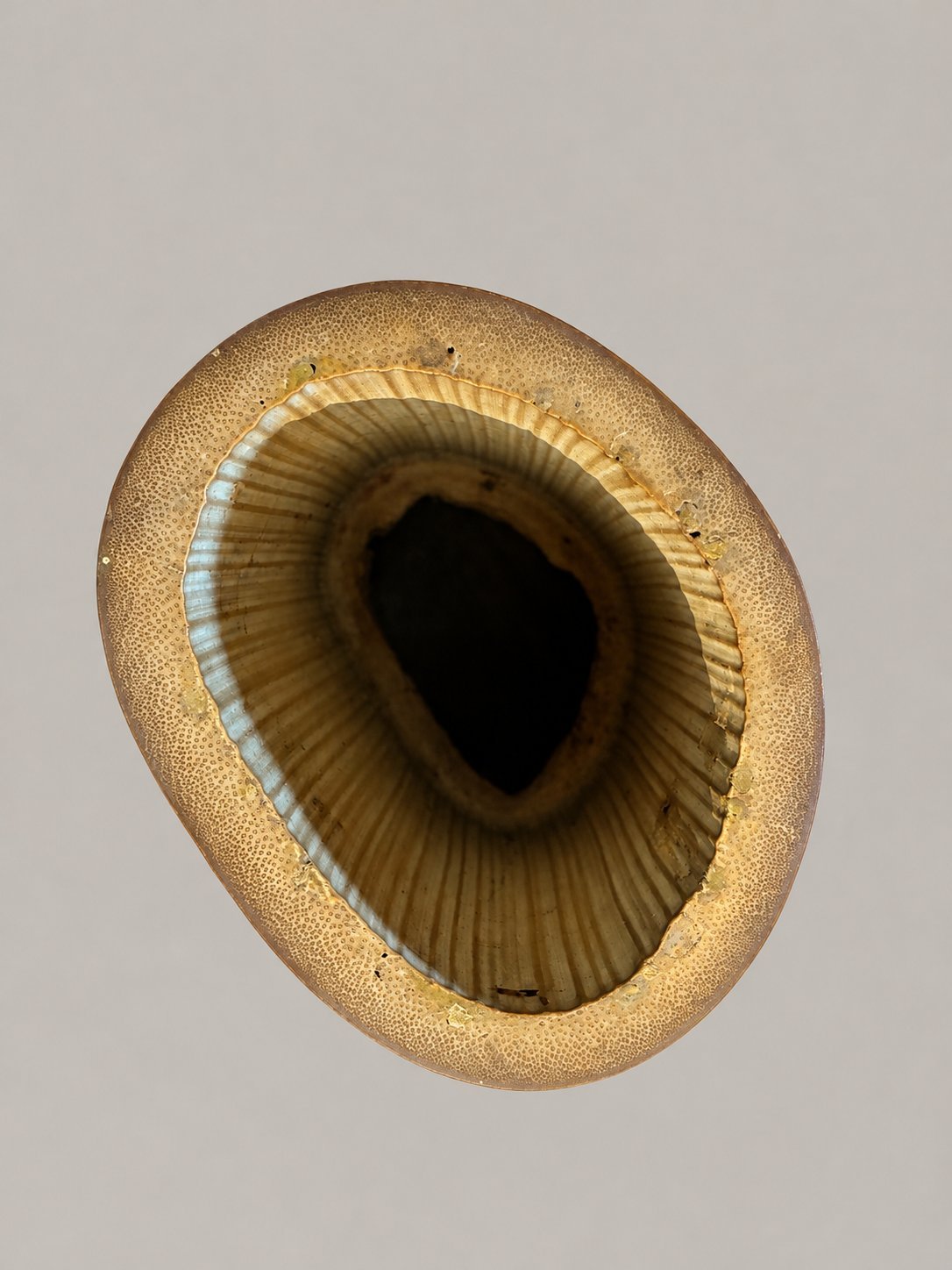
Seen from above: across the thick cross-section of the rim run the dotted tissues that match the vascular bundles of bamboo, and inside, lengthwise grain and working marks remain visible. The body is made from a single stout culm of bamboo, its mouth keeping a slightly oval outline. Beyond the carving, the outer wall leaves broad areas of honey-coloured ground bare, against which the relief and the fine-cut fur stand out the more sharply.
Dating the Piece
We date this brush pot to the Meiji period — not on any single point, but on several lines of evidence that interlock.
First, the presentation. Bamboo pot, separate hardwood base on three feet, a plaque inset beneath and signed: the whole object presents itself as a set, and a signed one. That is the characteristic posture of Meiji-period Japanese craft made for exhibitions and for collectors’ markets at home and abroad; Edo-period bamboo for the scholar’s desk was rarely mounted and signed in this way.
Second, the carving. The relief unrolls around the cylinder in one continuous scene; the fur is cut in thousands of fine lines that follow the muscle; the animals’ bone structure and postures are accurate to the point of the specimen-like. This realism is the “superlative technique” line that Meiji carving developed under the influence of Western realism. Edo small carving has its own refinements — but a composition of this scale, and this pictorial quality, matures only in Meiji.
Third, the subject’s coordinates in time. The Monkey–Crab tale gained an English chirimen-bon (crepe-paper book) translation in 1885 and entered the elementary reader in 1887; in Meiji it became a story the whole nation shared. To make a folktale into an object for the desk is a product of exactly that climate.
Fourth, material and condition. A whole stout culm made into a pot; the vascular bundles across the rim’s cross-section; the honey-coloured ground left on the outer wall — all are common features of bamboo carving in its Meiji flourishing. And the bamboo’s shrinkage cracks, the base’s wear and the overall patina are consistent with a survival of more than a century — age alone does not date a piece, but here it corroborates the other three. One qualification: the precision of this dating extends to “mid-to-late Meiji.” The workshop styles of late Meiji and early Taishō join seamlessly; a close in-hand look at the accretions in the carving’s recesses and at the cut marks could narrow it further. Until new evidence appears, Meiji is the conclusion we can stand on.
The Name Beneath the Base: Who Was Kakuho?
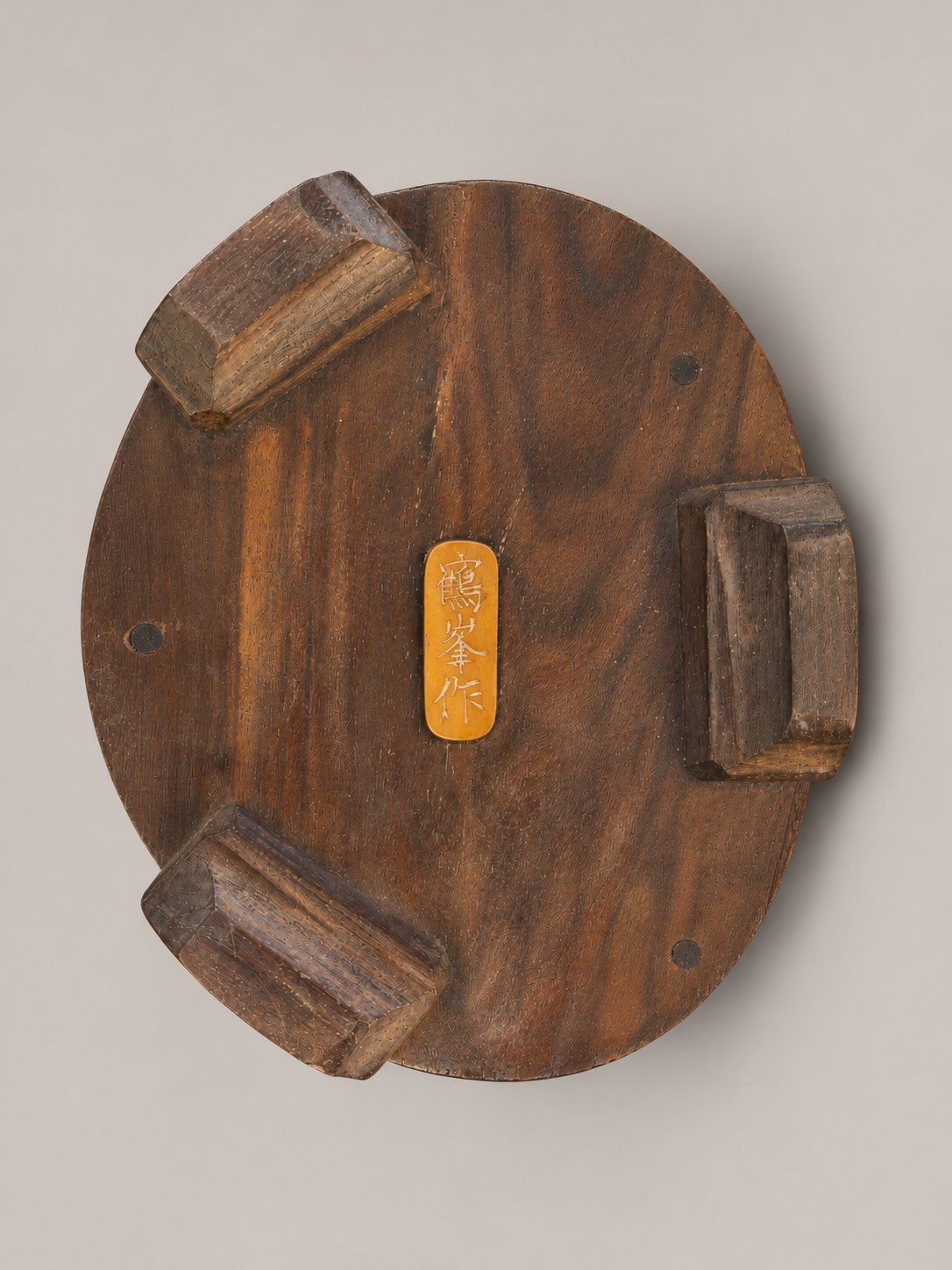
The plaque itself, with its three characters, gives the search a firm starting point. The difficulty is that more than one Japanese carver worked under this name, and the name must be rejoined to a particular pair of hands. And beyond the name, the plaque itself must match — completely.
The first lead is a netsuke carver of Gifu.
Published auction records identify this Kakuho as the father and teacher of Kanō Tessai. A wood netsuke of a karako catalogued by Zacke is signed with the two characters 鶴峯 and placed in Gifu in the mid-nineteenth century; the same catalogue cites the standard netsuke reference literature, and lists a Christie’s netsuke of Kuzu-no-ha with her child as a comparison. [7–8]
This lead is not weakened by the fact that some biographical sources write the name 鶴峰: 峯 and 峰 are variant forms of the same character, and published records of the carver’s work already use 鶴峯, exactly as on our plaque.
From netsuke to a bamboo brush pot, however, is a step still to be taken. The letterforms, the cut of the strokes, the placing of the signature and the carver’s modelling habits all need comparison. In the material we have reviewed so far, no bamboo carving has yet come to light that corresponds directly to this pot.
The second lead is Inoue Kakuhō of Okayama.
Inoue Kakuhō (1850–1919) is unusually well documented for a carver of his kind. The Okayama Prefectural Museum of Art records that he was born Kōji, the eldest son of Inoue Kinkai, a master shrine carpenter (miyadaiku) of Oku in Okayama — now part of Setouchi City. He inherited the family trade and specialised in the building and restoration of shrines and temples; in 1889 he assisted his father on the carved decoration of a festival float (danjiri) for the market quarter of their home district, and between 1895 and 1897 he directed the construction of a float for its eastern quarter — the full-body carving of a festival float being exactly where a shrine carpenter of his generation showed his finest work. [9]
Works by him survive in a public collection: a five-piece group of 1902 and a miniature doll-festival palace (雛御殿) of 1917, both held by the Okayama Prefectural Museum of Art. In his later years he also made desks, flower stands and tea utensils — a path from the great timbers of shrine architecture to small objects for the desk that is not uncommon among Meiji carvers, and the reason his name stands on our list of candidates. [9]
His working life fits the tentative Meiji date of this pot, and his recorded production of objects for use makes him a candidate worth keeping. But this remains compatibility of background: tea utensils are not brush pots, and so far we have found no direct record of him making a bamboo brush pot of this kind, nor a reliable image of his signature to set character by character against ours.
So if one name must be named as the most likely, it is Inoue Kakuhō: his working years fit this pot, and his production of desk objects is a matter of record. But suspicion is not attribution — until a signature comparison is made, the conclusion remains open. We have written to the curatorial department of the Okayama Prefectural Museum of Art, enclosing the unretouched photograph of our plaque and asking for their help in checking the signatures on the Inoue works in their care; we are awaiting their reply.
For the present, then, the pot is catalogued as:
Japanese bamboo brush pot with the Battle of the Monkey and the Crab, tentatively Meiji period, signed Kakuho saku; maker not yet identified.
Fortunately, an object need not wait for its maker to be settled before it shows its worth. Faced with so engaging a subject, carved with such care, any viewer will want to linger over it.
A Note on the Images
The object photographs in this article were taken under studio conditions and cleaned with AI assistance. Image 1, the unrolled panorama, is a digital reconstruction, offered to show the overall composition of the relief only; it is not evidence for dating or attribution. The Eisen surimono image derives from the book-page photograph on the British Museum’s collection page, perspective-corrected and cropped.
Sources and Comparative Works
[1] Heibonsha, Sekai Daihyakka Jiten (revised edition), entry “Saru Kani Gassen,” by Norimura Keiko. https://kotobank.jp/word/%E7%8C%BF%E8%9F%B9%E5%90%88%E6%88%A6-70073
[2] National Diet Library: Saru Kani Gassen, trans. David Thompson, illus. Kobayashi Eitaku, Kōbunsha, 1885. https://ndlsearch.ndl.go.jp/books/R100000002-I000000520143
[3] National Diet Library, Collaborative Reference Database: “Saru to kani to no hanashi” in Jinjō Shōgaku Tokuhon, vol. 2 (1887). https://crd.ndl.go.jp/reference/entry/index.php?id=1000159674&page=ref_view
[4] National Archives of Japan, “Learning in the Meiji Period”: on state textbooks. https://www.archives.go.jp/exhibition/digital/meiji/contents4_06/
[5] Andrew Lang (ed.), The Crimson Fairy Book, 1903 (Lit2Go, University of South Florida). https://etc.usf.edu/lit2go/142/the-crimson-fairy-book/
[6] Akutagawa Ryūnosuke, “Saru Kani Gassen,” Fujin Kōron, March 1923 (Aozora Bunko record). https://www.aozora.gr.jp/cards/000879/card140.html
[7] Galerie Zacke: wood netsuke of a karako, signed Kakuho, lot 190 — Gifu, mid-19th century. https://www.zacke.at/auction/lot/190-kakuho-a-fine-wood-netsuke-of-a-karako/?lot=59977
[8] Christie’s: a fine boxwood netsuke signed Kakuho, Edo period (19th century), 5 cm. https://www.christies.com/en/lot/lot-5255084
[9] Okayama Prefectural Museum of Art: artist record for Inoue Kakuhō (1850–1919). https://jmapps.ne.jp/okayamakenbi/sakka_det.html?list_count=10&person_id=36
[10] Edo-Tokyo Museum: Saru Kani Gassen miniature book, collection no. 90204165. https://www.edohakuarchives.jp/detail-32195.html
[11] MIHO Museum: Ike no Taiga, Saru Kani Gassen-zu, 18th century. https://www.miho.jp/booth/html/artcon/00002335.htm
[12] Ashmolean Museum: netsuke of a monkey embracing a crab, late 19th century; EA1956.1733. https://jameelcentre.ashmolean.org/collection/921/object/12056
[13] W. Stieber, Netsuke-Schnitzer-Familien, 1933 (OAG). https://oag.jp/img/2021/04/Jub_1933_2_04_Stieber.pdf
[14] British Museum: Keisai Eisen, “The Monkey and the Crab,” surimono, 1824; collection no. 1907,0531,0.448. https://www.britishmuseum.org/collection/object/A_1907-0531-0-448
This article was first published in Chinese on our WeChat account 衡艺轩. https://mp.weixin.qq.com/s/-oodRhppOAn2qLC2PUXoUw
New works and new research, first
Subscribe and we will email you when a new work is listed or a new Journal article appears. Nothing else — and you can unsubscribe at any time.
