The album
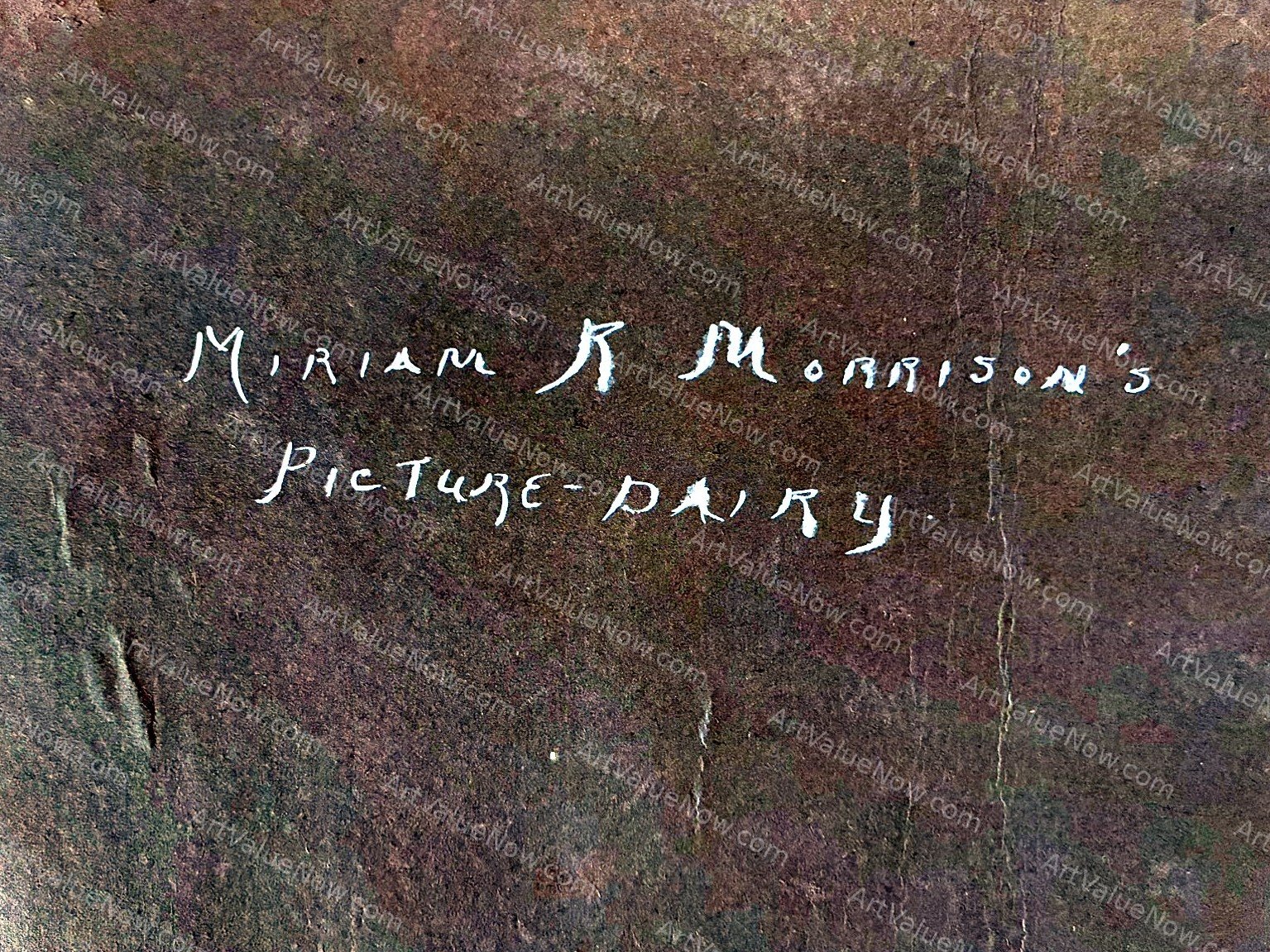
The album is bound in dark, crocodile-grained boards, closed with a cord strap, its two tassels worn. Inside the cover, her mother has written the title in white ink: Miriam R Morrison’s Picture-Diary.
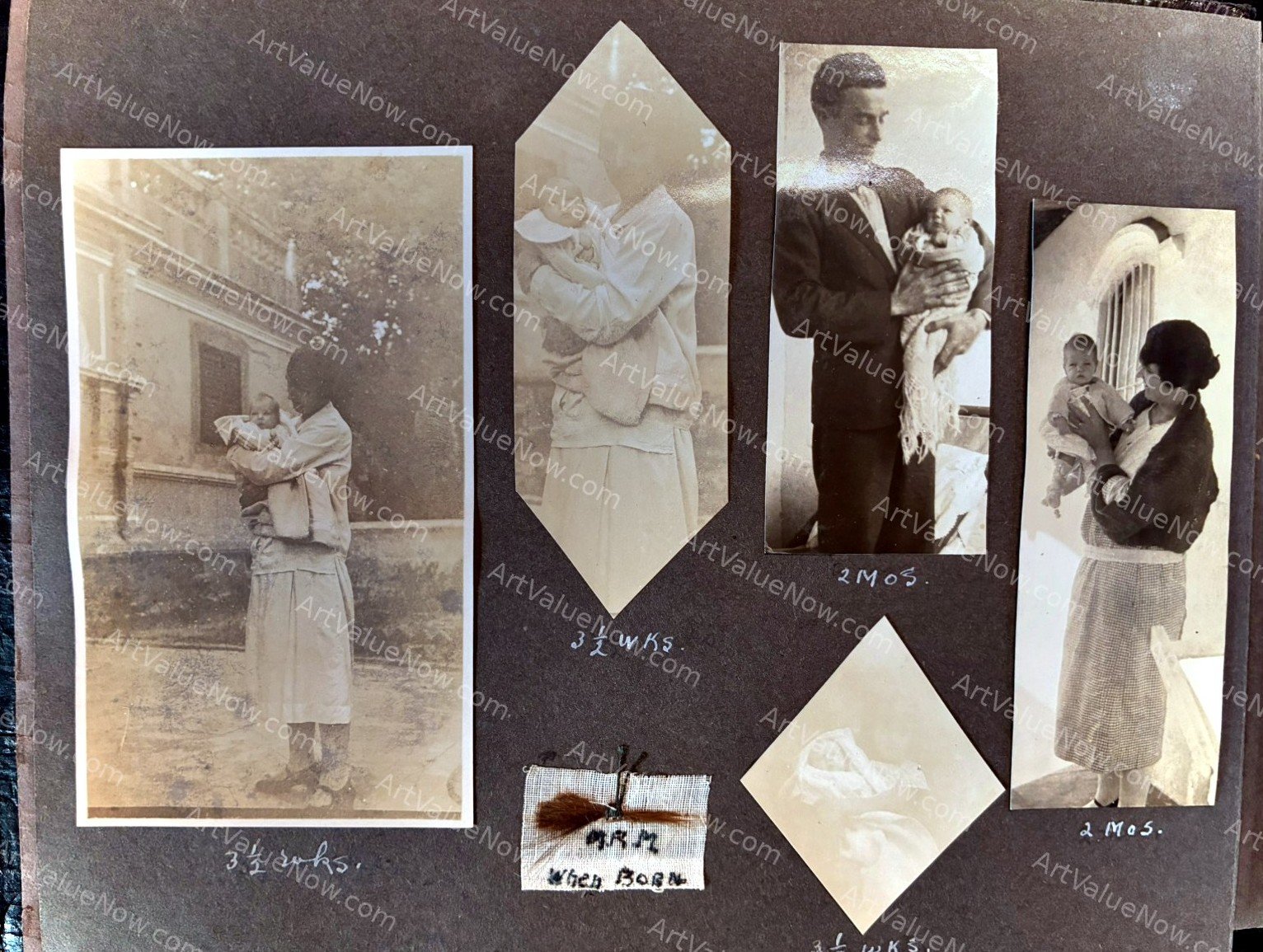
It is exactly that: a diary kept in pictures. Between 1929 and 1946 the Morrison family pasted in 162 photographs, each captioned on the photograph with a place and an age counted in years and months, and beside the photographs they sewed small bundles of a child’s hair, one for every year of her life, beginning with a wisp labelled, in ink on cloth, “M.R.M. — When Born.” Family albums exist in great numbers; few have survived this complete. This one can also be given back its names, its places and its dates. And when those are recovered, it is no longer merely one family’s keepsake: it takes on a wider historical significance, as a first-hand record of the early, sustained encounter between Canadian missionaries and the Chinese people, decades before the two countries formally established diplomatic relations.
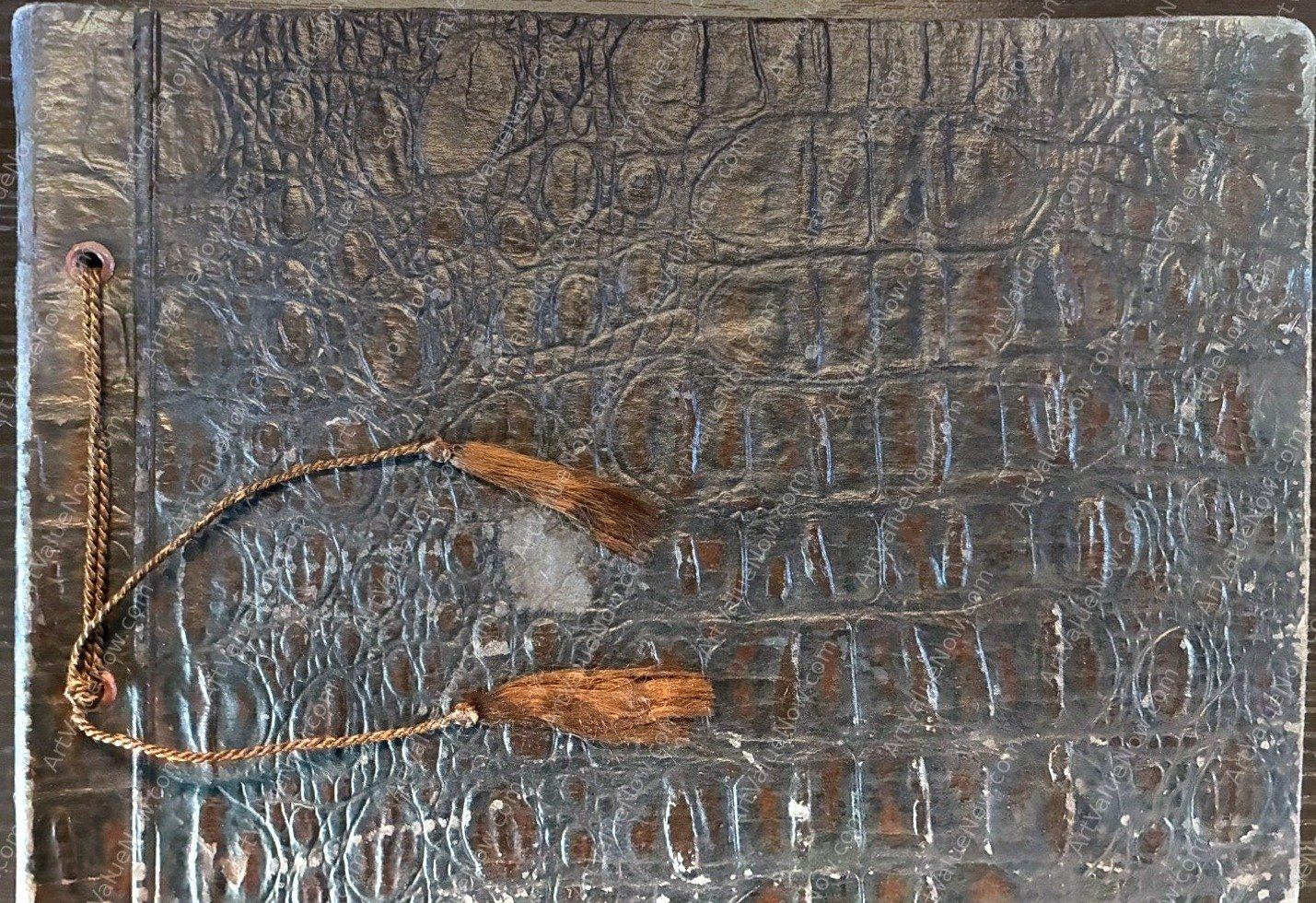
The album surfaced at auction in the United States in 2025, bearing no family’s name — only a line of description: “Canadian missionary in China photo album.” It passed through further hands before ArtValueNow acquired it, and our research restored to it the names, the places and the meanings set out below.
The Canadians who went to China
To understand what this album is, one must first understand the migration that produced it. In Canada’s early engagement with China, missions played a central role. In January 1888 a crowd of a thousand escorted Jonathan Goforth from Knox Church, Toronto, to Union Station: he was the pioneer of the Canadian Presbyterian Mission to Henan, and he would remain in China until 1935. That same year the China Inland Mission’s first North American party sailed, recruited largely through Toronto. Canadian Methodists followed to Sichuan in 1891, building over decades a mission whose crowning work, West China Union University at Chengdu (1910), they shared with partner churches. French-Canadian Catholic orders came in strength as well. By the 1920s, several hundred Canadians — preachers, doctors, nurses, teachers — were living in China under church auspices, running hospitals, schools and universities from Manchuria to Guangdong. For more than half a century, until well after the Second World War, these missionaries were, in effect, Canada’s presence in China: the only Canadians most Chinese ever met, and the main channel through which most Canadians came to know China.
The Pentecostals were latecomers to this company, and among those whose beginnings were the most modest. The Pentecostal Assemblies of Canada, organised in 1919 by just thirty-three churches, was a small and widely suspect sect — only the year before, Canada’s tribunals had refused to recognise its members’ claim to exemption from combatant service. Its missionaries went not to the great treaty ports but to inland county towns, where they put down roots and lived — and it was to such a town, Tsing Yuen (Qingyuan) on Guangdong’s North River, that a young Ontario farmer named J. Elmor Morrison brought his family in the 1920s. The fellowship has since grown into the largest evangelical denomination in Canada, with more than a thousand congregations and some 270,000 members; Morrison belonged to it before it had a name or an organisation, and his life spans the whole of its growth, from its founding to its maturity. Missionaries of his generation did not visit China; they moved there. They married, raised children, buried their dead and grew old in Chinese towns, and their children — born in China, schooled between two worlds — formed a distinct and now almost vanished generation. Miriam Morrison was one of them, and her picture-diary is their monument.
1929: A birth on the Peak
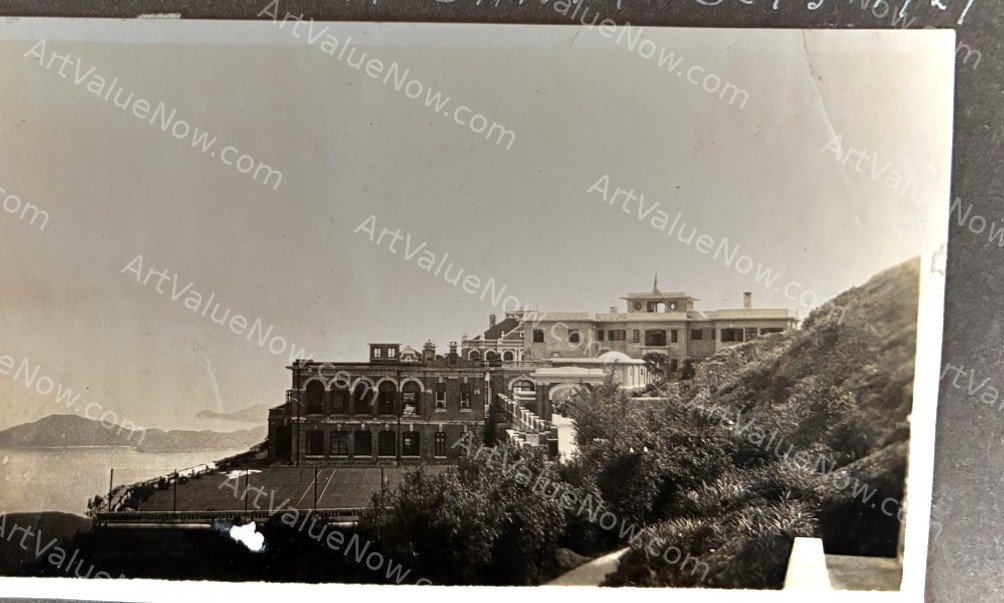
The first photograph is not of the child but of a building: the Matilda Hospital, high on Hong Kong’s Peak above the harbour. The caption, written with a child’s pride in two worlds at once, reads: “MY BIRTH PLACE IN CHINA — OCT 5-1929.”
There is a reason the album begins with a hospital. The mission stations of South China were county towns days downriver from the coast, and their medical provision was what the missionaries themselves could carry in a bag. For a confinement or a serious illness, mission families travelled — down the North River and along the coast to Hong Kong, where the Matilda Hospital, founded in 1907 on the Peak, served the foreign community. A great many “China-born” missionary children were therefore, like Miriam, born in Hong Kong.
Miriam R. Morrison was born there on 5 October 1929, the youngest of four children of the Reverend J. Elmor Morrison (马理信, 1896–1965) and his wife, Canadian missionaries of the Pentecostal Assemblies of Canada stationed at Tsing Yuen. Canada and China would not establish diplomatic relations until 1970. But Canadians had already been coming to live in China for more than forty years by then — and the Morrison album is that pre-diplomatic history told from inside one household.
The father: conscience, calling, and a life’s work
Elmor Morrison’s road to Qingyuan began with an act of conscience. A young farmer from Moorefield, Ontario, he was called up in the First World War and, as a Pentecostal, refused combatant service. The Canadian tribunals of 1918 did not recognise his church’s claim to exemption, and he spent two years in solitary confinement in Kingston Penitentiary — a case still cited in scholarship on Canadian Pentecostal pacifism. The man who would not carry a rifle for his own country carried, instead, a Bible to the other side of the Pacific, and gave China the rest of his working life.
The seminary he later founded preserves the outline of his life in its official history: its predecessors, it records, “have begun Bible classes in China to train Chinese preachers for many years” — long before he formally founded a school, Morrison was already running training classes at Tsing Yuen. In 1939, with V. J. R. Mills, he co-founded the Ming De Bible School at Pak Wan, Qingyuan. Through the war he stayed at his post; in February 1942, from Tsing Yuen, he was reporting on the condition of Hong Kong’s interned civilians into what became British Colonial Office files. In 1947, in Guangzhou, he founded the Ecclesia Bible Institute and became its first president. Driven south by the change of regime, he rebuilt it in Hong Kong — Cheung Chau in 1949, then land bought at Sha Tin in 1953 and a campus opened in 1954, work in which he had a hand throughout and which he pressed forward. The congregation he gathered at Kau To Village, Sha Tin, still gathers for worship; the Sha Tin Assemblies of God church grew from the same community. He returned to Canada in 1960 and died in 1965.
His contribution endures in the institution he founded. That institution is today Hong Kong’s only Pentecostal seminary fully accredited by the Asia Pacific Theological Association, its courses spanning undergraduate to doctoral study — in 2006 it launched the first Chinese-medium Doctor of Ministry among globally accredited Pentecostal seminaries. As early as the 1930s he was a pioneer of the educational principle on which that success rests: that the church in China must be led by Chinese leaders, that those leaders should be trained in Chinese, and on Chinese soil. His schools seem to have existed precisely to make foreign missionaries dispensable. In 2002 the seminary’s ownership passed formally from the American and Canadian missions to a local body, Ecclesia Ministries Limited: the founder’s intention, completed two generations on. And beyond the church, his name survives in the scholarly record of his own country — as a documented case of conscience in the First World War, and as the author of a wartime report that still sits in Britain’s archives. He left his footprints in those records, and in another kind of record besides: in the memory of the Chinese students he trained — and in the church he helped to build, which lived on past the end of the mission age that had sent him to China.
Tsing Yuen: an exchange written in daily life
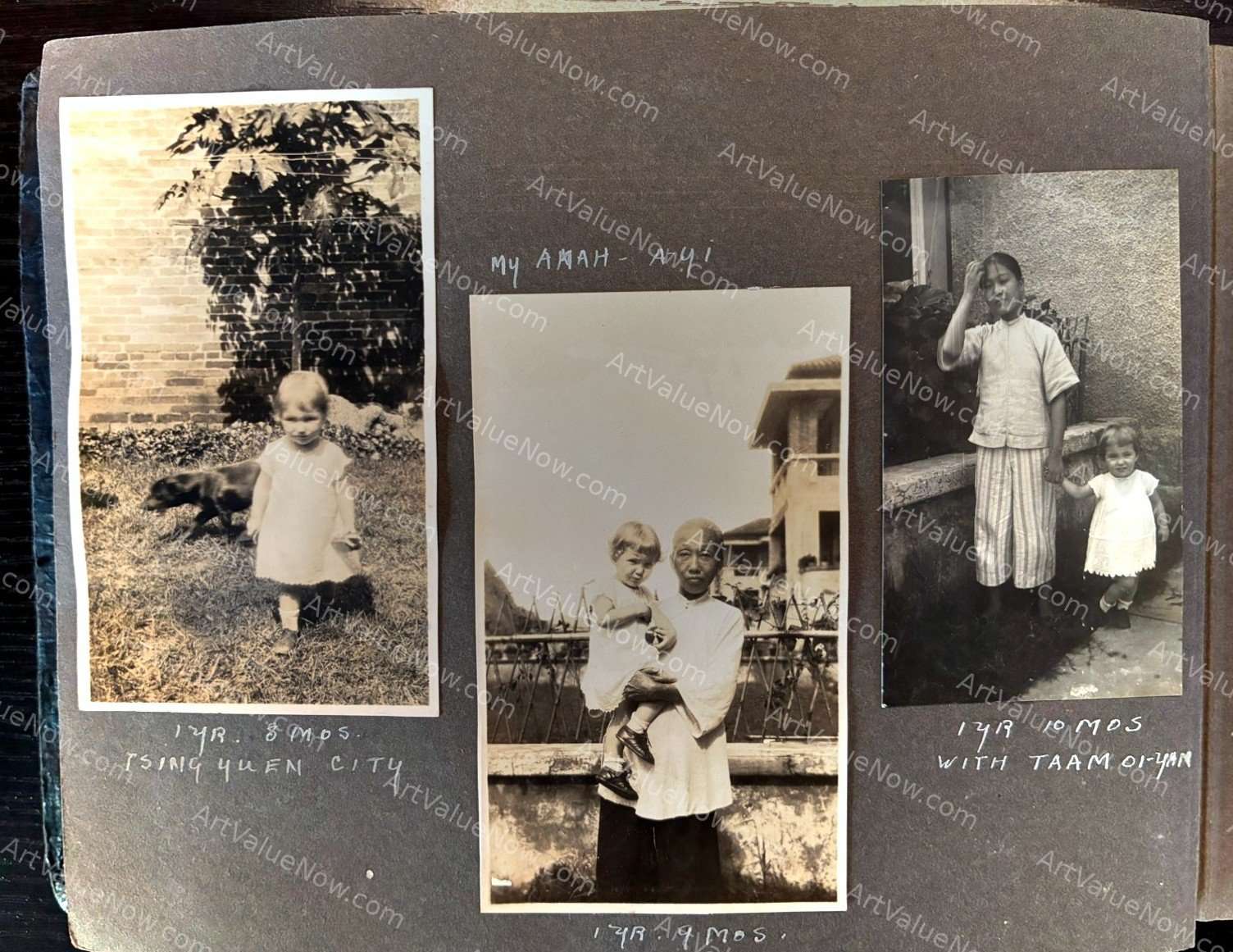
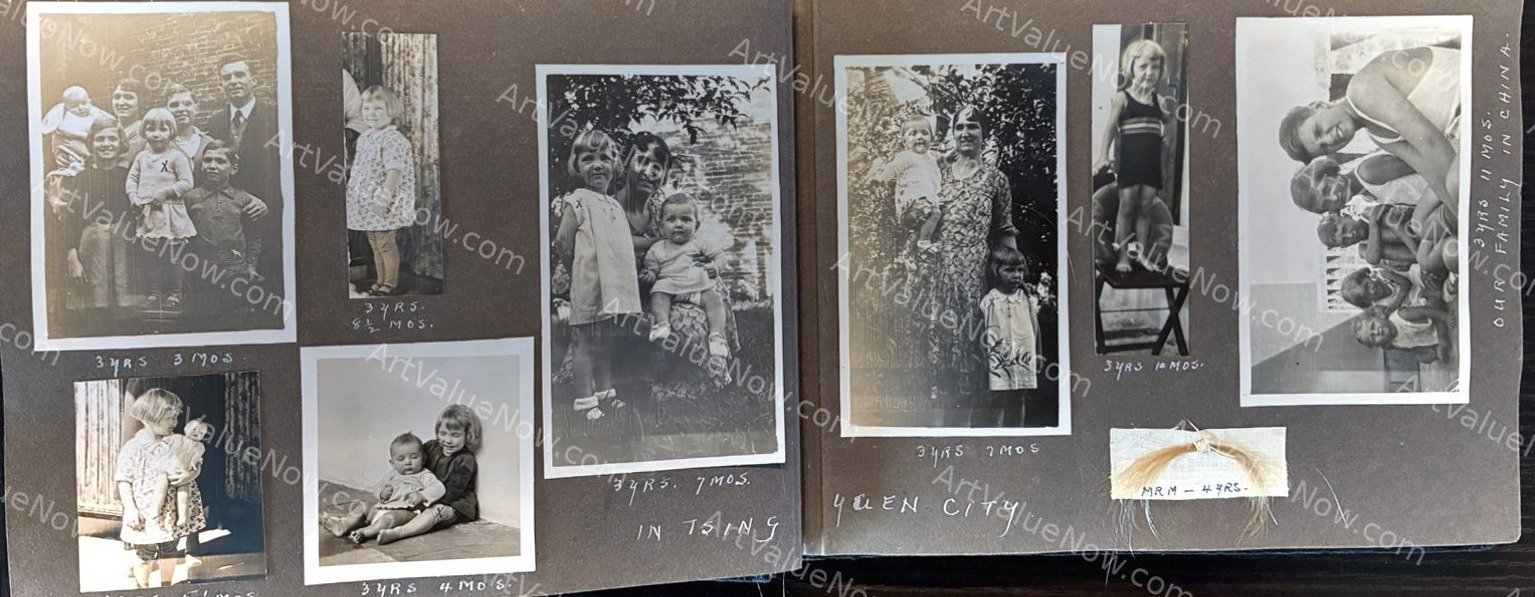
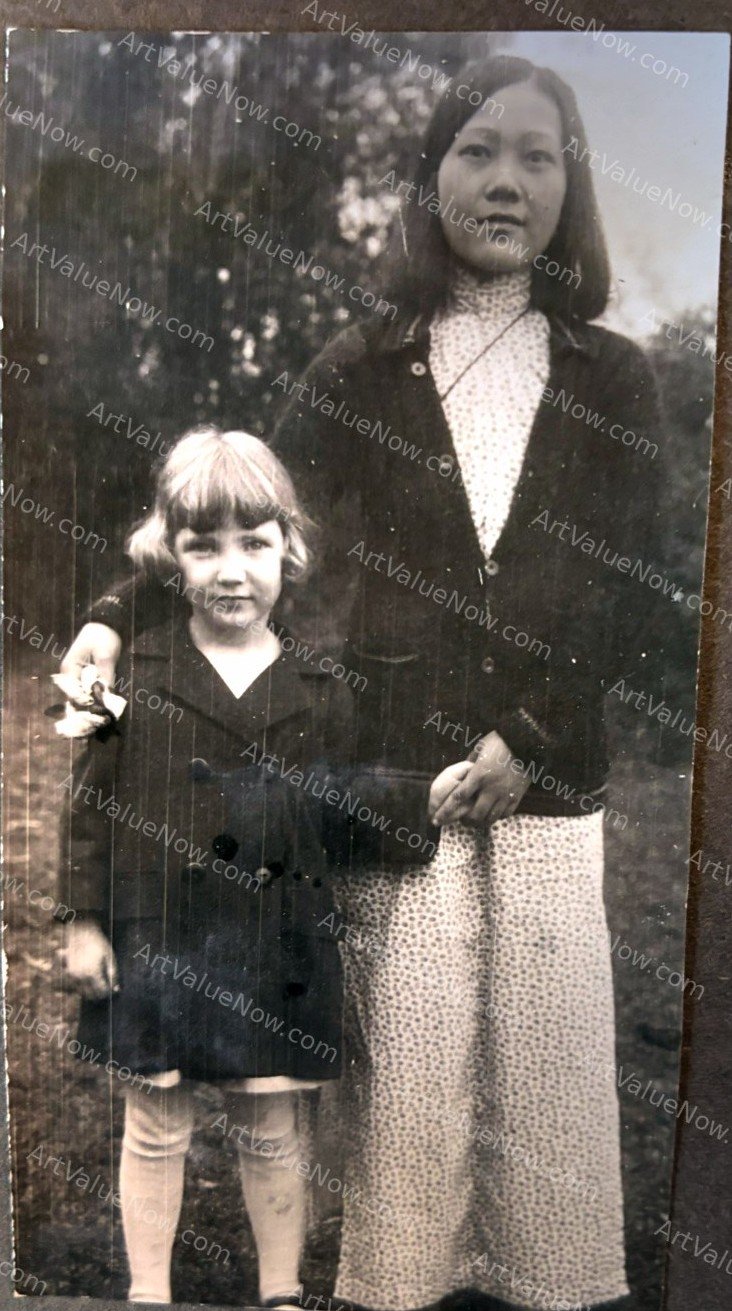
What the album records of the 1930s is not preaching but proximity. At one year and nine months Miriam is in the arms of “MY AMAH — A-YI,” her Chinese nurse; at one year and ten months she holds hands with a young Chinese woman the caption names, carefully, in full: Taam Oi-Yin. At three, she poses with her father and the mission community of Tsing Yuen City (January 1933); at three years and eleven months, under the words “OUR FAMILY IN CHINA,” she sits with her mother and siblings on a veranda — the phrase itself a small declaration of where home had come to be. At five and a half, in April 1935, she stands hand in hand with a young Chinese woman of the town, the two of them looking levelly at the camera as equals in the frame.
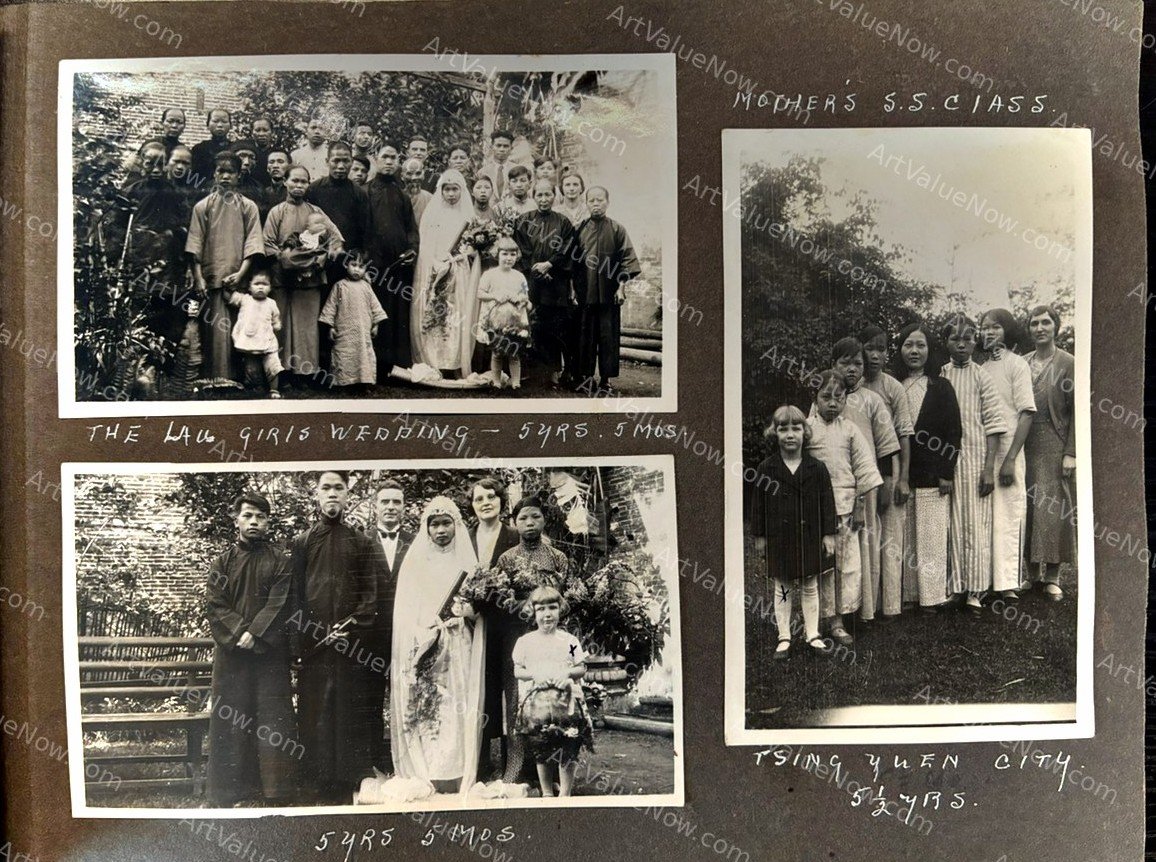
And in March 1935 comes the album’s most eloquent page. One photograph shows “MOTHER’S S.S. CLASS” — Miriam’s mother seated among the Chinese women of her Sunday School. Below it, two more: “THE LAU GIRL’S WEDDING.” The bride wears a white Western gown and veil; the guests are Chinese and Canadian together; and at the front, marked with the family’s habitual blue ×, stands the little flower girl — five-year-old Miriam, holding the bouquet.
A Canadian child as flower girl at a Chinese Christian wedding in a Guangdong county town in 1935: a record like this could only be produced by a life lived closely in common.
Growing up: friends, school and church
The album holds many more photographs besides: Miriam with her friends, and records of her taking part in the activities of church and school, of her education, and of her everyday amusements. They show that her growing up happened not only within the family, but among companions, in the classroom and in the life of the church. They record how one missionary family raised a child overseas, and they preserve concrete fragments of a child learning, making friends, and living between two cultures.
Considered as a document, an album of this kind served not only to preserve family memory. It could also be used to report to the sending church and its supporters on the growth and upbringing of missionary children: its photographs and captions turned a child’s life into a record that distant relatives, friends and church people could follow, so that overseas mission work appeared not only as reports of preaching and of schools, but as the daily life of one family. This album may therefore also be read as an important document for understanding how early overseas missionaries presented family life and the raising of children to their churches — though whether it was ever actually used for formal reporting remains, for now, a question for further research.
1938–1939: The crossing, and the portrait
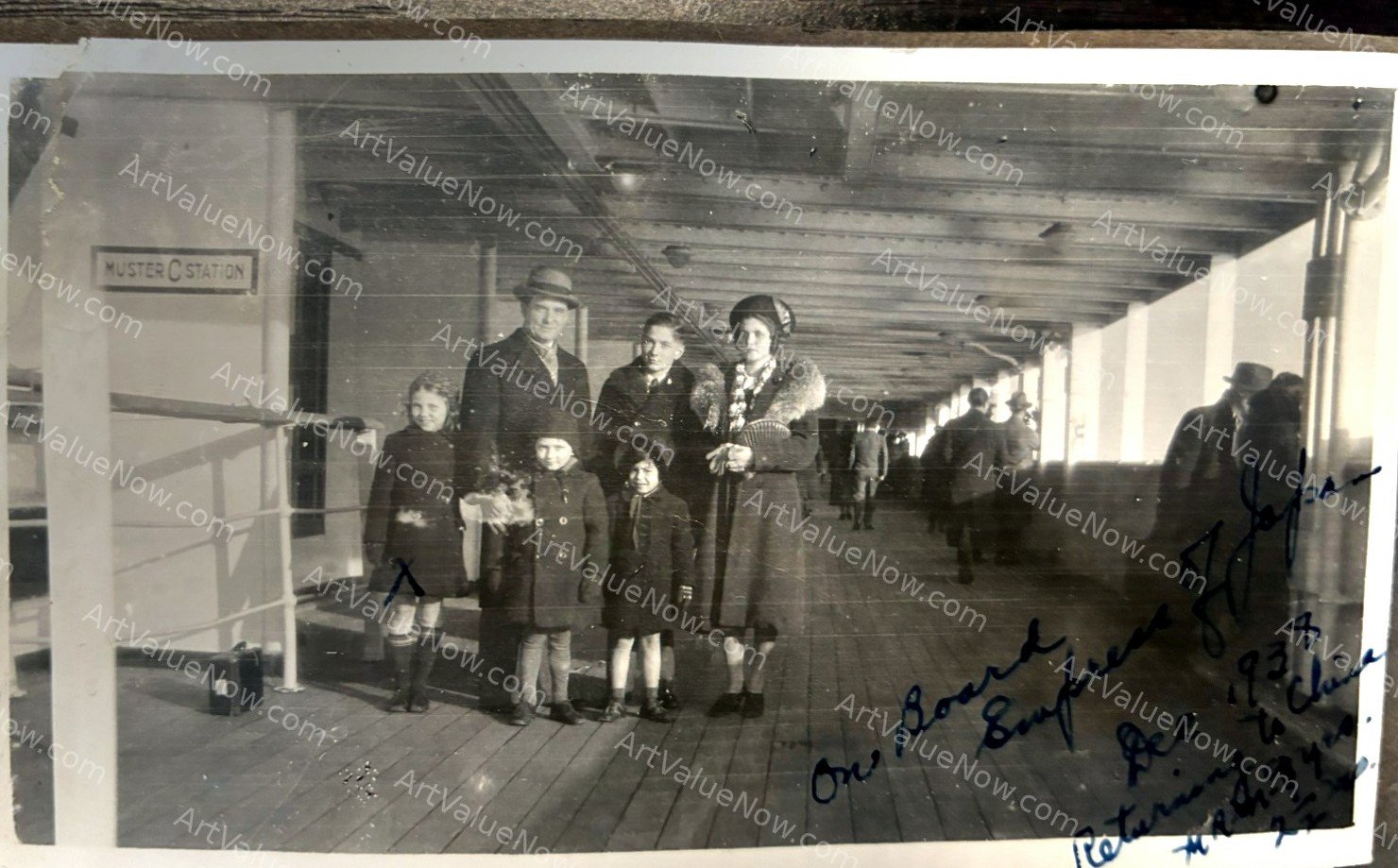
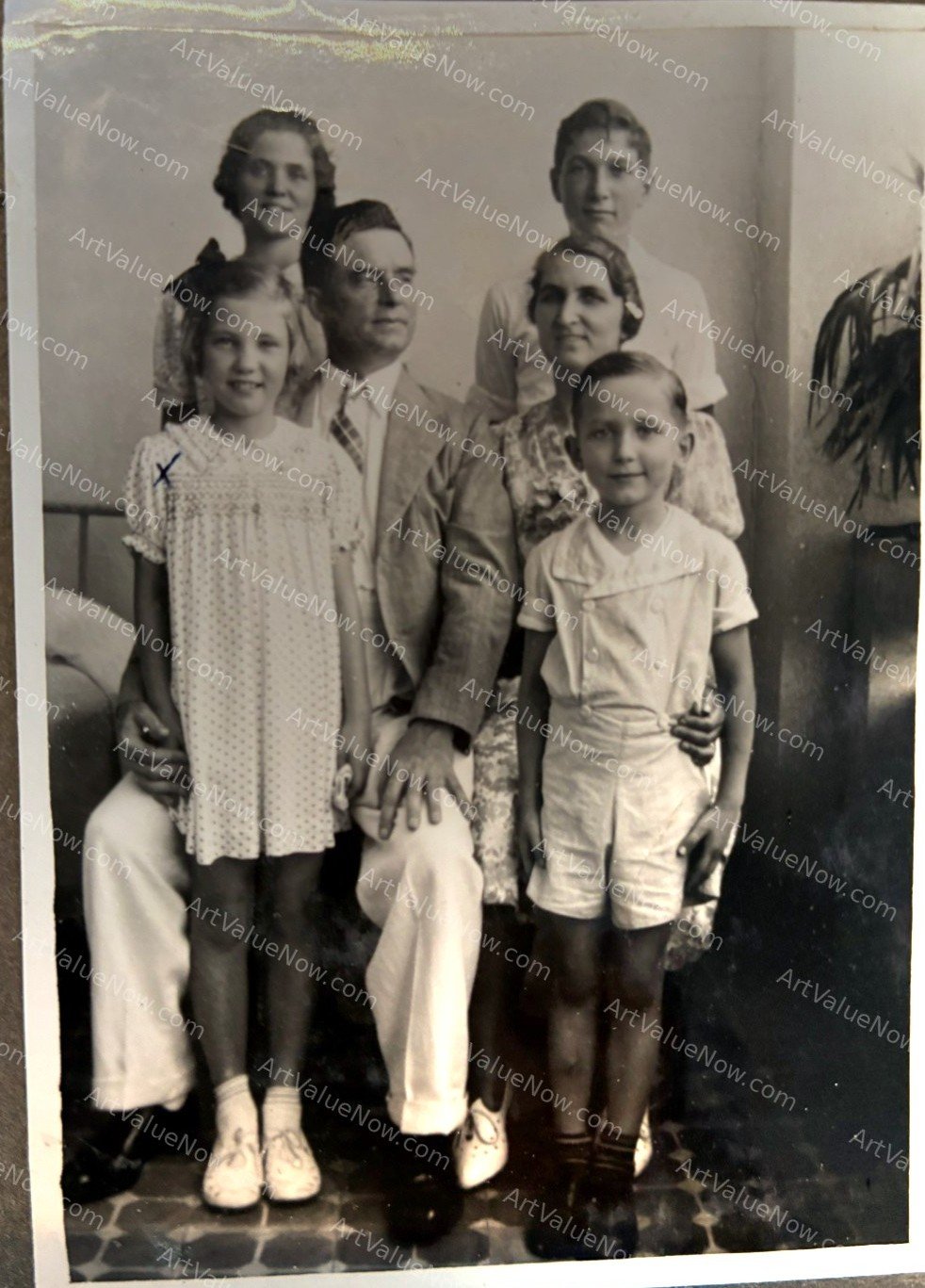
In December 1938, after a furlough in Canada, the family sailed back to a China already at war. On the promenade deck of the Canadian Pacific liner Empress of Japan, beneath a sign reading “MUSTER C STATION,” all six of them gathered — parents in heavy winter coats, the children ranked by height, Miriam marked once more with the × — and the blue ink across the corner says: “On Board Empress of Japan, Dec. 1938, Returning to China.” They reached Hong Kong on 30 December. Seven months later, in July 1939, the family sat for a studio portrait in tropical dress — the last photograph of all six of them together in China, captioned with the diary’s usual precision: “9 YRS. 9 MOS.”
Of what followed that last family portrait — how Morrison travelled and built his work in the years after, and how many meetings and partings still lay ahead for him and for Miriam — the photographs and the writing say nothing. Those unrecorded moments we can only imagine.
War, and a family on two shores
Then the cruel war forced this family to a painful choice: separation.
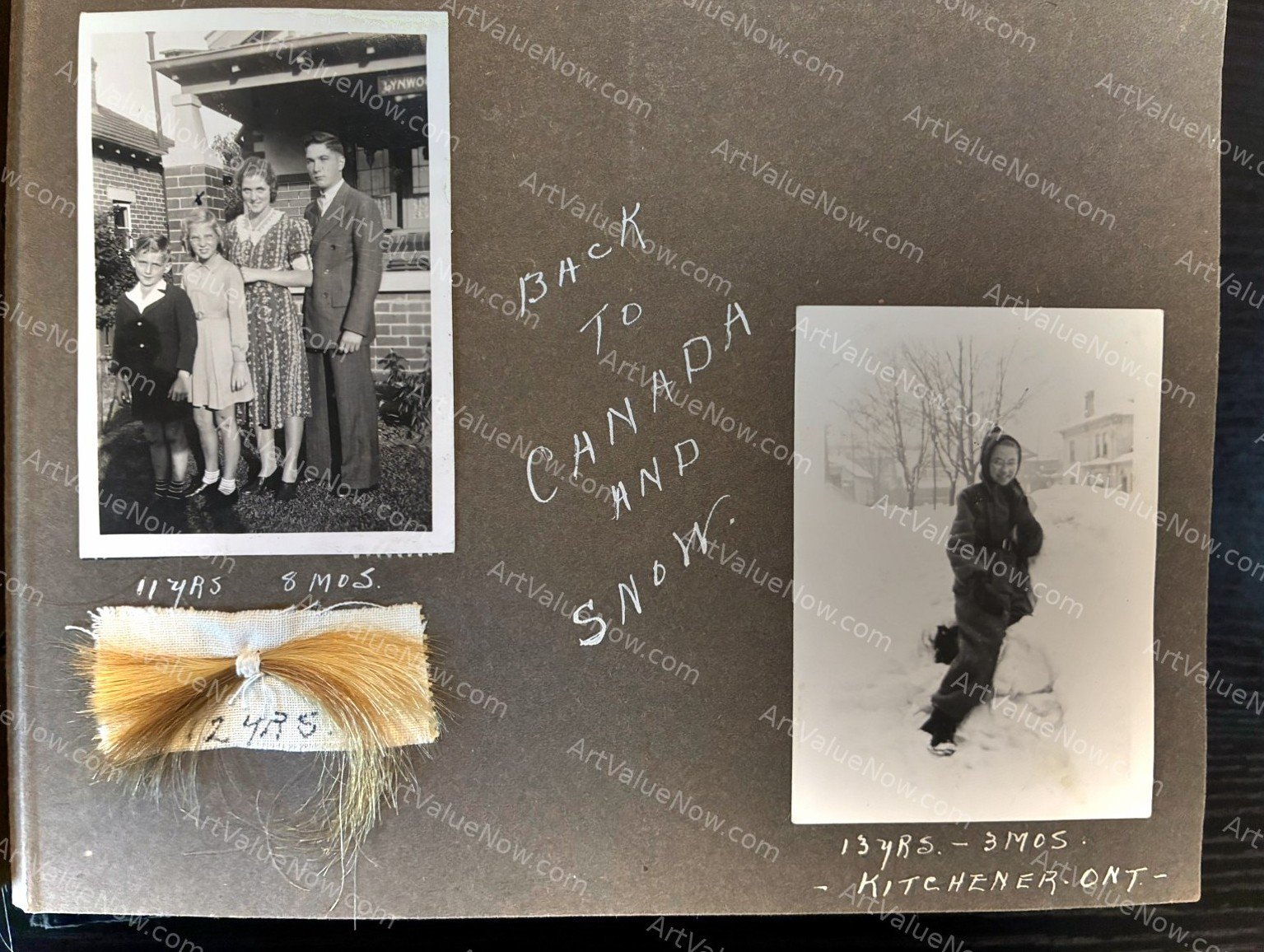
The album records Miriam and her siblings just after their return to Canada, under a heading in large letters: “BACK TO CANADA AND SNOW.” Beside a lock of hair labelled “12 YRS,” Miriam stands with her mother and her brothers outside a Canadian brick house — the tall young man beside her mother is her elder brother; her father is absent from what should have been a family photograph. In the photograph beside it, at thirteen years and three months, she lies laughing in deep snow, and the caption gives the place: “KITCHENER, ONT.” — January 1943.
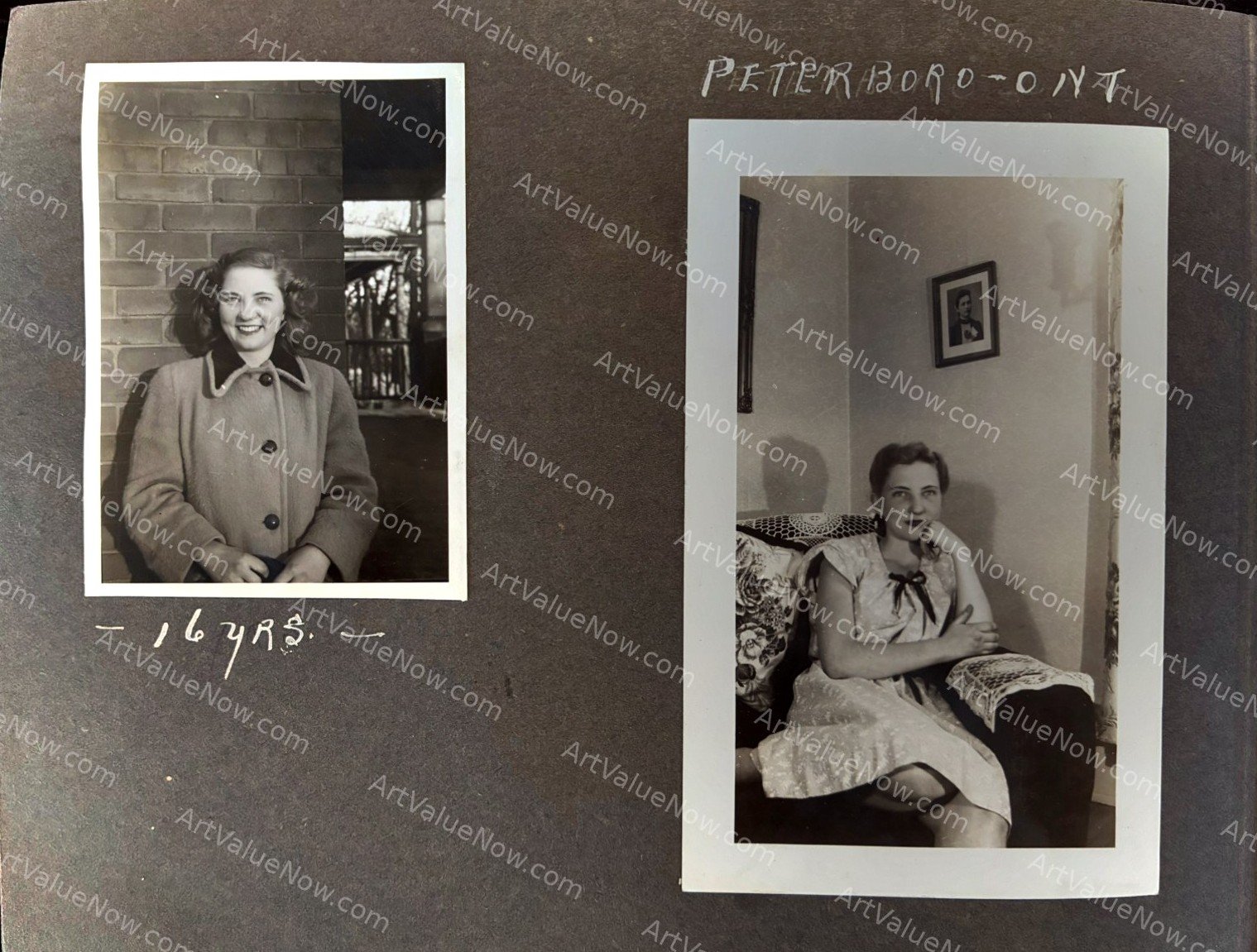
The children had come back to a country Miriam had never lived in, and their father had not come with them: in February 1942, from Tsing Yuen, he was writing reports on the plight of Hong Kong’s interned civilians that found their way into British Colonial Office files. He stayed at his post; his children grew up in Ontario snow. By sixteen Miriam is photographed in Peterborough — a young woman now, seated in a parlour, a framed portrait on the wall behind her.
27 October 1946: The parting gift
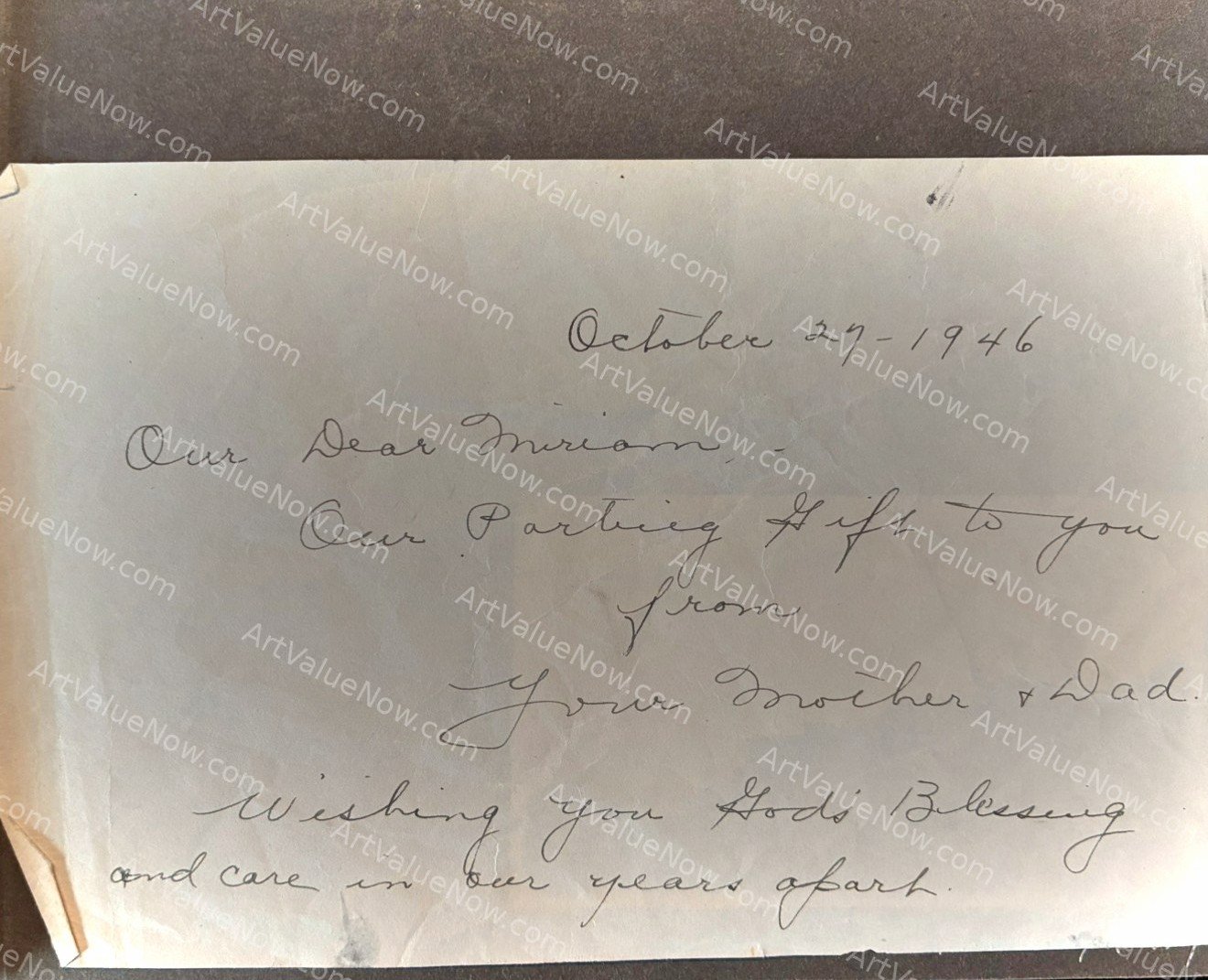
Pasted into the front of the album is a letter. It is dated 27 October 1946, three weeks after Miriam’s seventeenth birthday, and it is written in her mother’s hand:
Our Dear Miriam,
Our Parting Gift to you
From Your Mother & Dad.
Wishing you God’s Blessing and care in our years apart.
The Morrisons were going back. In 1947 Elmor Morrison founded a Bible institute in Guangzhou and became its first president; when circumstances forced the work to Hong Kong, he rebuilt it there — at Cheung Chau, then on land he acquired at Sha Tin in 1953, where the campus opened in 1954. The school he founded survives today as Ecclesia Theological Seminary in Tuen Mun; in 2027 it will mark the eightieth anniversary of its founding. He died in 1965, having given nearly forty years to the work in China.
The album was the bridge the parents built across the separation they knew was coming: seventeen years of a life, pressed between its covers, so that the daughter who stayed in Canada would carry China — and them — with her.
Why this album matters
Family albums of the China mission era survive in numbers; but in our research to date we have found none to equal this one. Four qualities coincide in it, and it is their coincidence that gives it its distinctive weight.
It is identified. The family is named, the father is a documented historical figure — the founder of an institution that still teaches in Hong Kong today — and the album’s internal evidence agrees, at every point we have checked, with mission directories, institutional histories and wartime archives.
It is complete. Around one child, from birth to seventeen, it keeps an unbroken record: 162 photographs, the locks of hair kept year by year, dated captions, and the farewell letter that explains how the album came to be given to the daughter as a parting gift. The whole survives intact, with no sign of having been split, culled or deliberately “improved.”
It is rare. Visual records of Canadian Pentecostal work in South China — a small mission, in inland county towns, whose archives are thin — are scarcely to be found; a named, dated, family-level record of the Qingyuan station in the 1930s is, to our knowledge, without parallel in private hands.
And it is, above all, human. What this album tells is the daily life of a Canadian missionary family in China in the late nineteenth and early twentieth centuries, through that country’s most turbulent years — in an amah’s arms, in a Sunday School class, in a flower girl’s bouquet, in a mother’s handwriting bracing for “our years apart.”
The years passed. Not until 2025 did the album resurface — in an American auction room, anonymous; the auction house did not even know who its subjects were. It passed through further hands before coming to ArtValueNow. It took us nearly a month of research to give it back its identity.
That this resurfacing should come on the eve of the eightieth anniversary of the Ecclesia Theological Seminary in Hong Kong that Morrison founded gives it a particular resonance.
It is a witness: to a century of encounter, and of lives lived side by side, between the peoples of Canada and China.
And it is an echo: of a young man who crossed the ocean with his wife to a wholly unfamiliar land, built his work there, put down roots and raised his children — and of a parent’s love, recognised once more.
The Morrisons, pasting a hospital photograph into a baby’s diary in 1929, could not have imagined that, nearly a century later, their album would at last be able to tell its own story.
Research continues. Miriam’s mother’s full name, the names of the three older children, and Miriam’s own later life in Canada remain without clear record in any source we have consulted; our enquiry to the Pentecostal Assemblies of Canada Archives is still awaiting a reply, and we would welcome word from any reader who knew this family.
References
- Ecclesia Theological Seminary, official history (English)
- Ecclesia Theological Seminary — 70th anniversary celebration, 2017 (Asian Center for Pentecostal Theology)
- Knox College (Knox 200) — the commissioning of Jonathan Goforth, January 1888
- OMF — the first North American China Inland Mission party, 1888
- John D. Meehan, Chasing the Dragon: Canada’s Early Relations with China, 1858–1952 (UBC Press)
- Murray W. Dempster, on Morrison’s imprisonment, Canadian Journal of Pentecostal-Charismatic Christianity 4 (2013); summary: https://mhs.mb.ca/docs/mb_history/87/firstmartyr.shtml
- Directory of Protestant Missions in China (1936), Morrison entry at Tsingyuen
- V. J. R. Mills biography (Ming De Bible School, Pak Wan, 1939)
- Morrison’s report from Tsing Yuen, 10 Feb 1942, British Colonial Office file CO 129
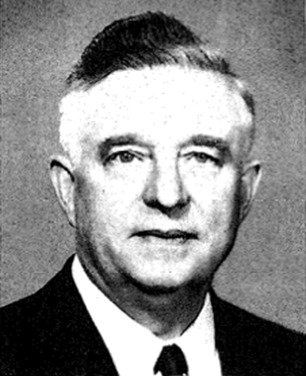
- Kau To Village church, Sha Tin — our story (incl. the closing portrait of Morrison)
- Pentecostal Assemblies of Canada — founded 1919 by 33 churches; 1,047 congregations and 271,893 members (2022 denominational census), Canada’s largest evangelical denomination
- Auction record of the album (HiBid, Lot 14 Auctions, 13 Mar 2025)
A note on the images
Unless otherwise noted, the album photographs in this article were prepared from the original album held by ArtValueNow. Credit for the holding of the original and for the preparation of its digital images does not constitute a claim to copyright in the original photographs. External images are credited in their captions.
