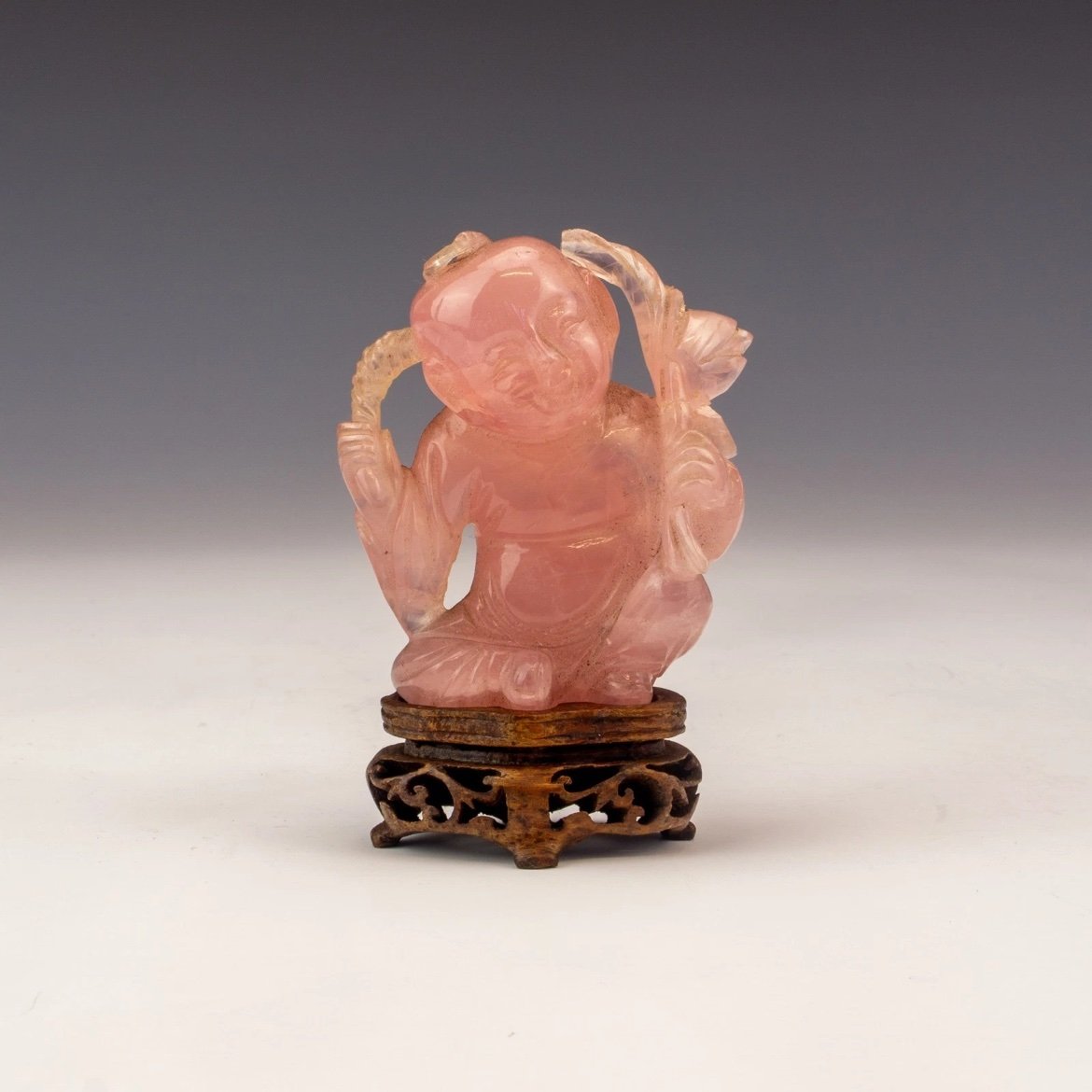
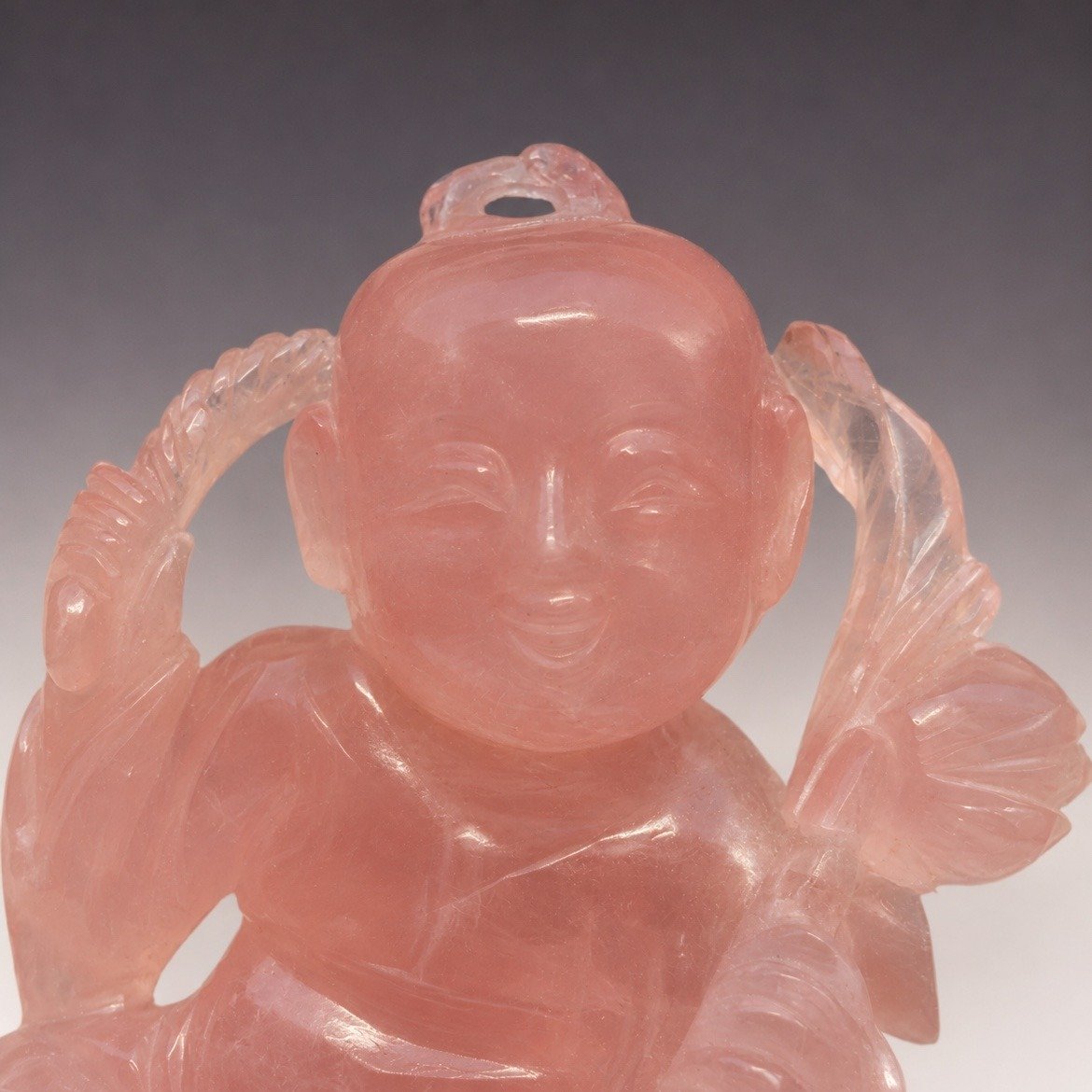
This rose quartz figure of a boy is just 6 centimetres high, not including its wood stand. The boy sits with his right leg folded and his left knee bent, his head inclined slightly forward, both hands gripping a lotus stem that bears a bud, raised behind his head, his eyes curved in a smile. The quartz is rich and saturated in colour, like peach blossom in the third month. Apart from a few natural wisps within the crystal, it is translucent almost throughout, and its colour is even.
A round face, a plump little body, an uninhibited smile — a small figure, full of spirit.
The Colour of Rose Quartz
Rose quartz — also called furong jing, “hibiscus crystal” — is quartz of a pink colour. The stone here is rich in tone and fairly even overall, yet its colour shifts with the thickness of the carving: deeper at the cheeks and the body, paler and brighter towards the edges, so that with light behind it the rim of the leaf is especially clear.
A Subject a Thousand Years Old
The boy holding a lotus is a classic subject in Chinese carving. The Metropolitan Museum of Art in New York holds a rock crystal boy with a lotus of the Liao dynasty, made around the 11th to 12th century, 9.4 centimetres high. The boy grips a lotus stem, in a dancing pose. Nearly a thousand years ago, a carver was already cutting this child in crystal.
A pair of Liao-dynasty rock crystal boys, formerly in the collection of Sam and Myrna Myers, measure 7.5 and 8.9 centimetres and were published in The Language of Adornment in 2002. The auction catalogue discussing them cites Ellen Johnston Laing’s research connecting the subject with the Double Seventh festival of the Song dynasty: at the festival, children in Bianliang and Hangzhou carried fresh lotus leaves, imitating the festival doll Mohele. The Palace Museum in Beijing holds a Song-dynasty white jade boy with a lotus, 7.2 centimetres high, both hands raising the lotus above his head — quite a different pose.
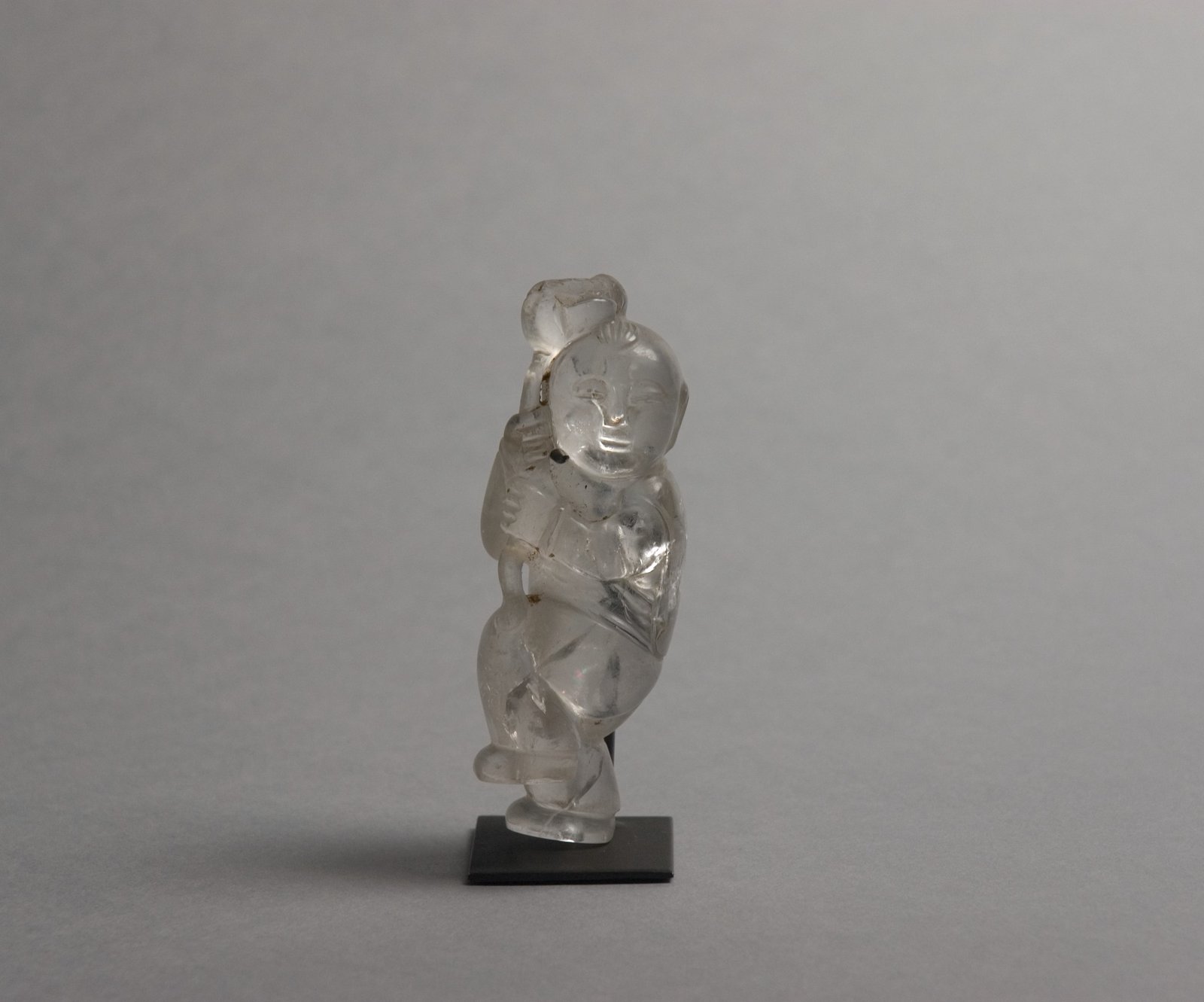
The figure of the boy with a lotus remained in use for centuries and acquired an auspicious meaning: lian, the lotus, is a homophone of lian, “in succession,” and a boy with a lotus is read as “sons in succession.” In the Ming and Qing dynasties the subject is found in jade, agate, lapis lazuli and rock crystal alike. The Royal Collection in Britain includes a Qing-dynasty boy holding a lotus in pale greenish-white jade, only 5.1 centimetres high, close in size to the present piece. Christie’s has also offered a rock crystal boy with a lotus dated to the 19th century, 13 centimetres high.
Craftsmanship and Date
Small carvings in jade or crystal almost never bear an inscription; the date must be judged from the parts of the object itself, taken together.
Proportions. The figure is of “three-head” proportion: the head large, the body short, the form full — the conventional proportions for a young child in carving. A large head and a short body have been the sculptural language for boys since the Song dynasty, so proportion alone cannot separate one dynasty from another; but this figure’s big head, fat face and short, full body agree with the typical form of Qing-dynasty jade boys.
Posture. The boy sits with his right leg folded and his left knee bent, the upper body leaning slightly, the head bowed a little forward. The bow is the result of the action: he is raising the lotus stem behind his head, and his head lowers with the movement of his hands. Such a seated posture is often seen in jade boys of the Ming and Qing.
Hairstyle. The front and sides of the head are shaved, and hair is left at the back, its strands cut in fine incised lines. The hair is gathered at the crown, rising into a small knot, and the braid is plaited from there down to one shoulder. Before the Qing, a boy’s hair was dressed in buns and tufts: in the Song, two small buns at the sides and one in the middle; in the Liao, two strands combed apart, falling behind the ears; in the Ming, often a peach-shaped bun — never a braid. The braid is the Qing man’s hairstyle: shaved in front, the hair left behind, plaited and hanging down the back.
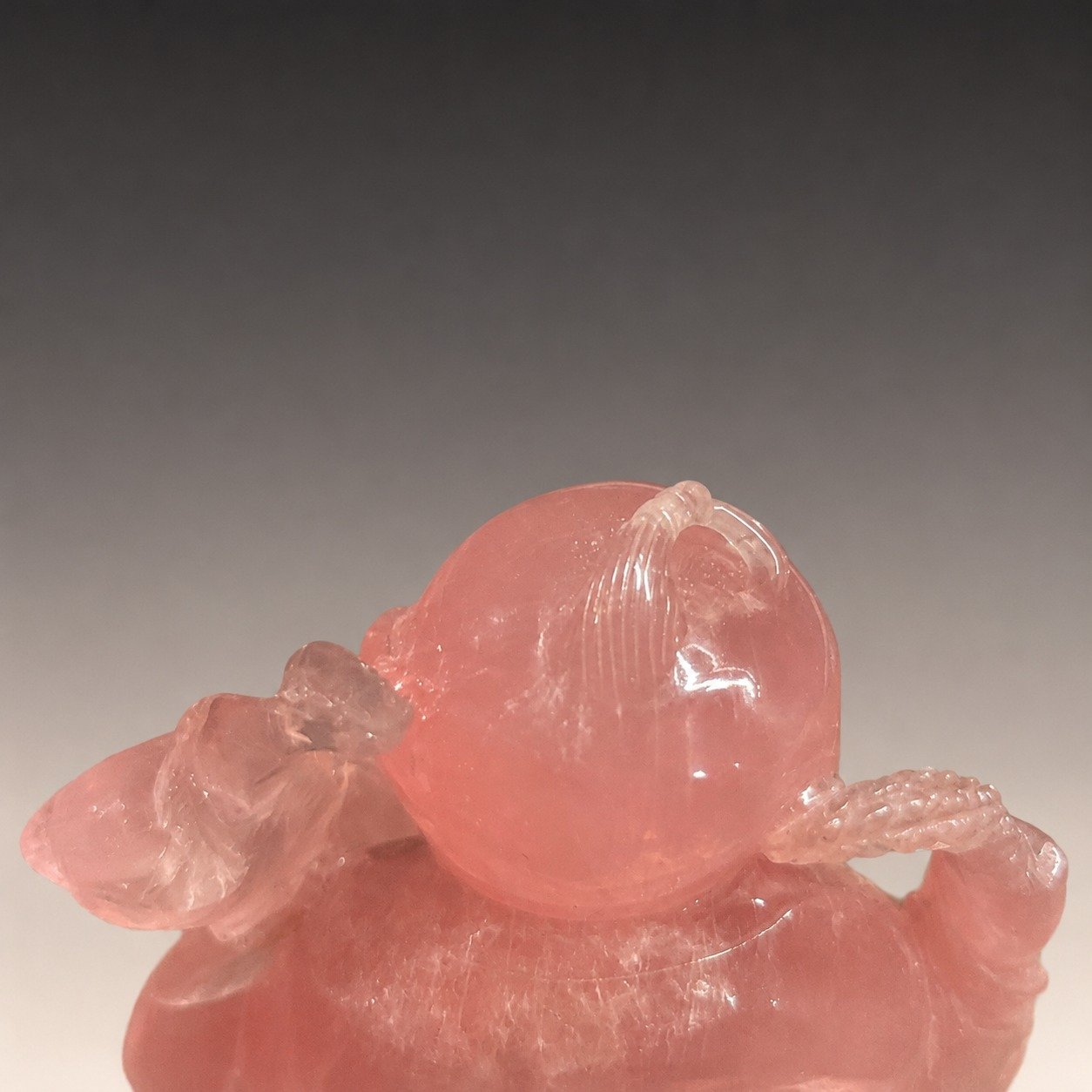
The form of the lotus. What the boy holds is a lotus stem bearing a bud: the bud is unopened, and on the stem grows a single small lotus leaf, carved very thin. Song-dynasty boys with lotuses mostly raise the flower high above the head with both hands; here the stem with its bud is raised behind the head, its position following the seated posture and the tilt of the head — the piece’s own composition, not the Song formula.
Features and carving. The features are modelled in the round, and their modelling is concentrated. Rose quartz transmits light, and a photograph taken straight on easily flattens the shallow modelling; turn the piece a little, and the brows and eyes, the tip of the nose and the corners of the mouth appear one by one — the smile lies in the subtle transitions between the corners of the mouth and the two cheeks. The folds of the robe are drawn throughout in fluent arcs, running unbroken around the sides and the lower edge, with no sign of the uniformity of modern machine work.
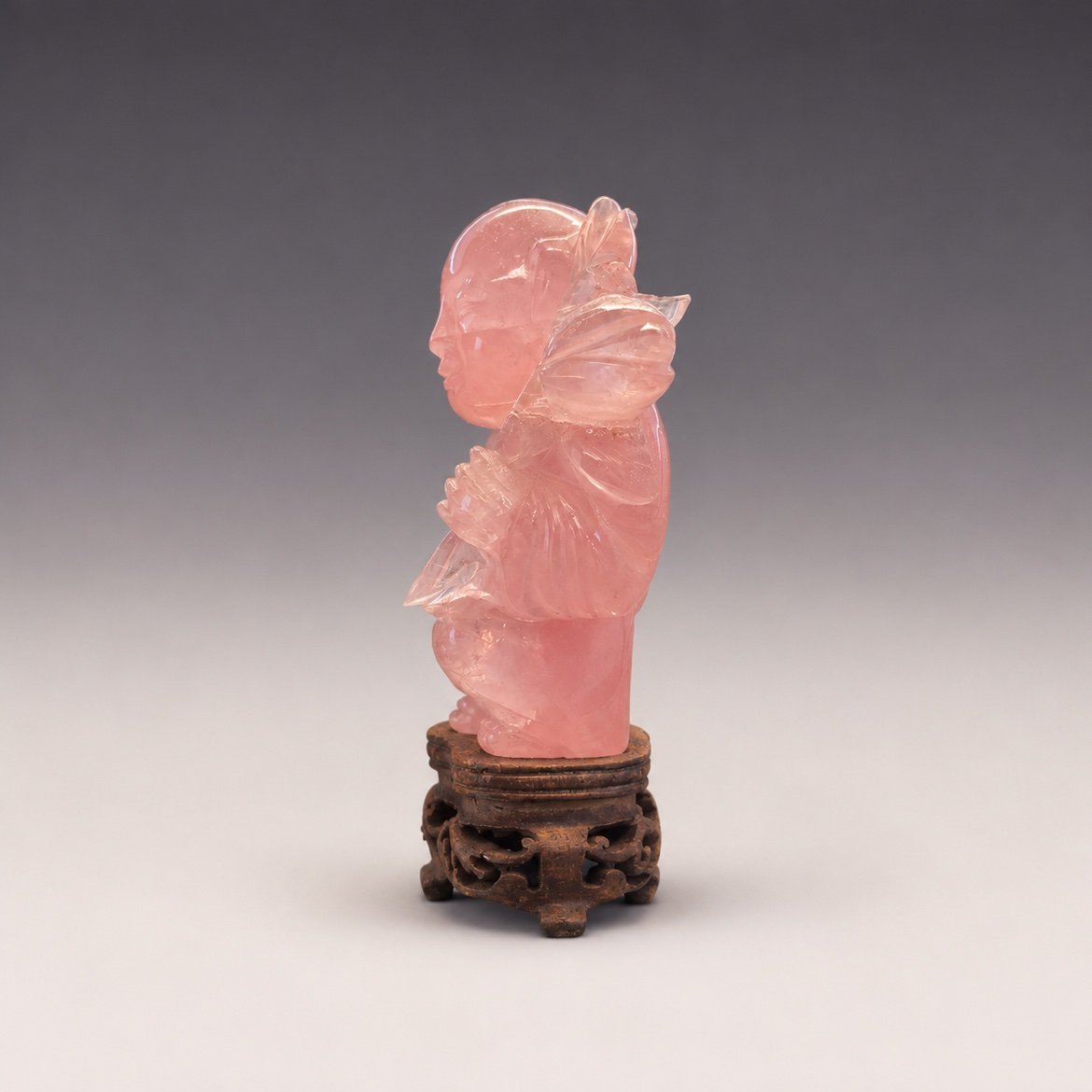
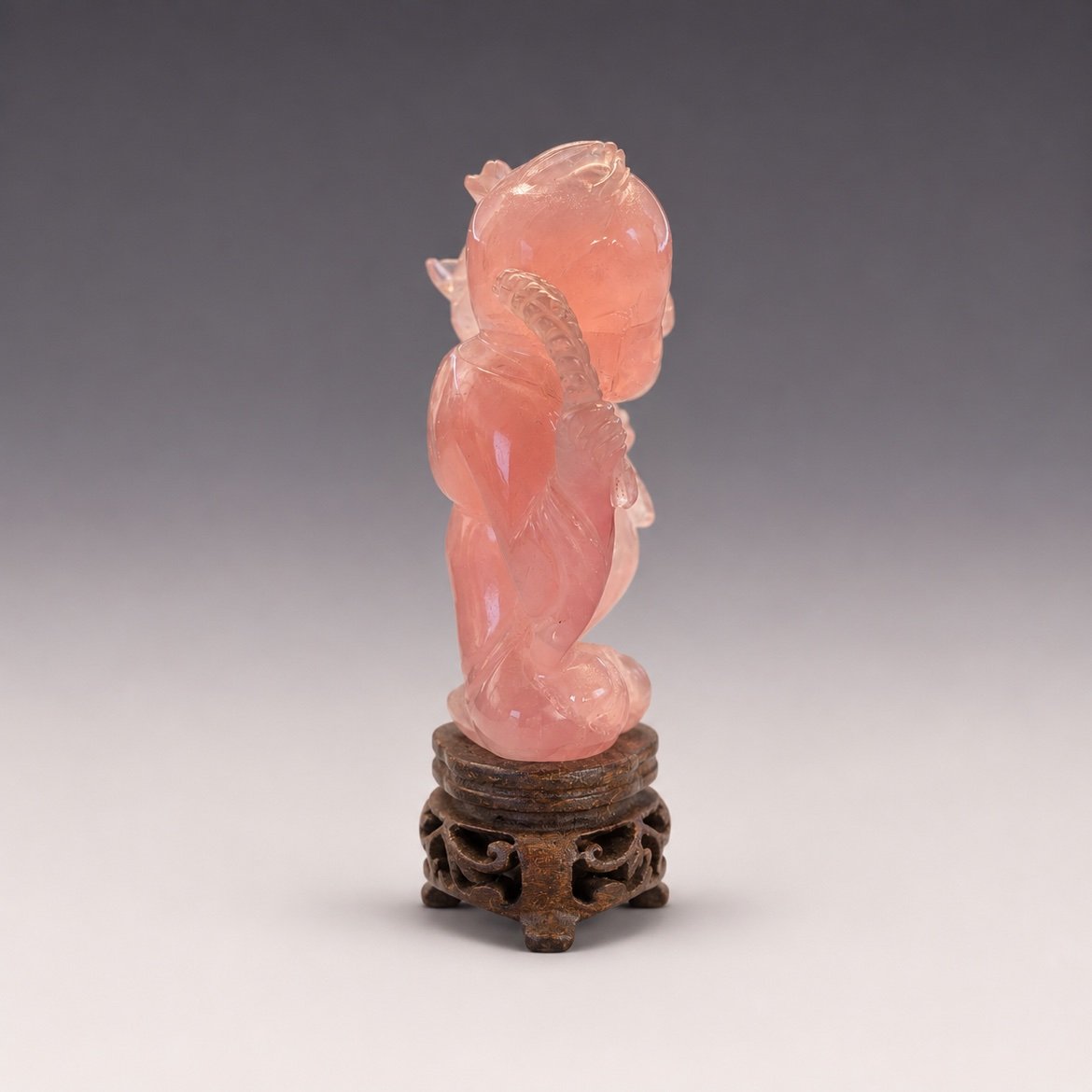
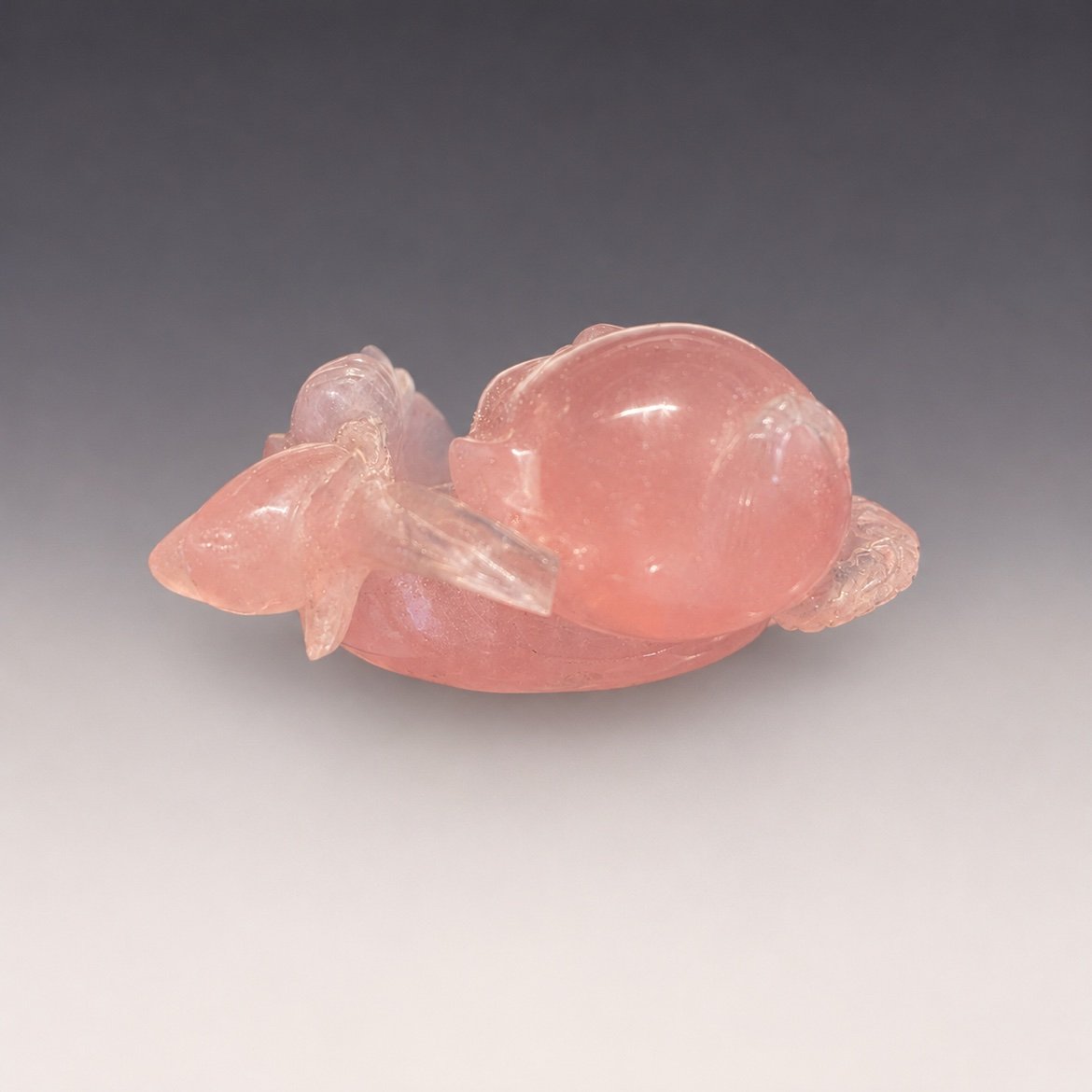
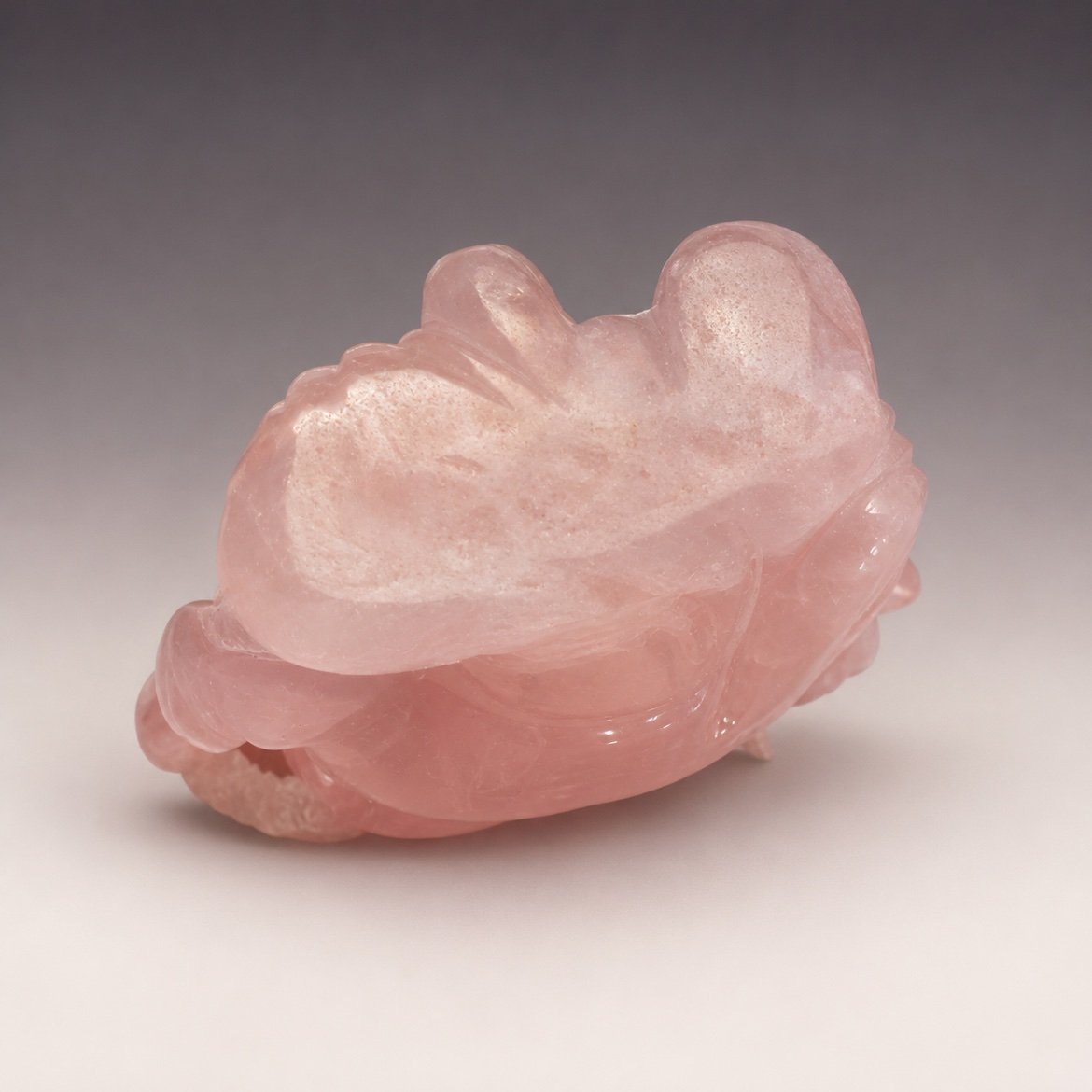
The base. The underside is finished by hand, with a slightly frosted, matte surface. The folds of the robe are carved even into the underside that no one sees, so that when the piece is turned over the direction of the drapery can still be read; this hand-worked, matte texture is of a piece with the carving of the whole figure.
The wood stand. The upper plaque of the hardwood stand is shaped to fit the base of the figure, and is carried on a pierced stand below. The pierced work still holds fairly coarse gouging marks, while its edges are rounded and their colour deepened. The plaque fits the figure closely; the stand should be original to the piece.
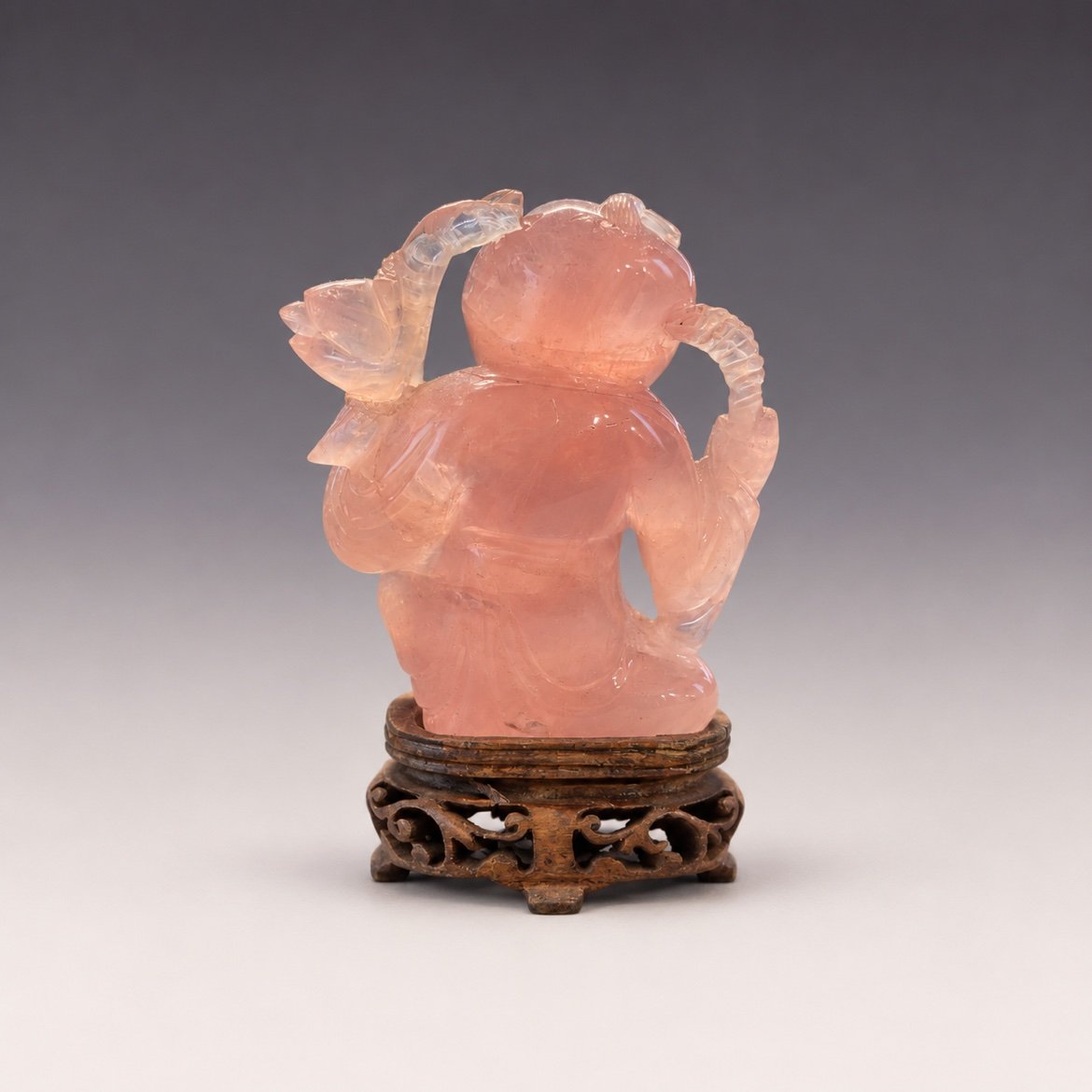
Taking the proportions, the posture, the hairstyle, the form of the lotus, the carving and the treatment of the base together, and the wood stand into account as well, the piece can be dated to the late Qing dynasty.
Condition
The lotus stem held in the boy’s left hand is damaged in one place and has been restored. The figure itself is otherwise well preserved; natural wisps can be seen within the crystal, and no crack runs through the piece.
Catalogue Entry
Chinese rose quartz figure of a boy holding a lotus, late Qing dynasty. The boy sits with his right leg folded and his left knee bent, his head inclined slightly forward, smiling. In his left hand he holds a lotus stem with a bud, raised behind his head; in his right hand, a small lotus leaf about to open. The rose quartz is rich in colour, with a few natural wisps within the crystal. The lotus stem in his left hand is damaged in one place and has been restored. With its original fitted pierced hardwood stand. The figure 6 cm high, excluding the stand. Acquired by ArtValueNow in October 2025.
Sources
- Boy with a lotus, Liao dynasty, The Metropolitan Museum of Art, New York (object no. 2008.326): https://www.metmuseum.org/art/collection/search/74522
- A pair of rock crystal boys and lotus carvings, Liao dynasty, formerly Sam and Myrna Myers Collection: https://drouot.com/en/l/32365093-a-pair-of-rock-crystal-boys-and-lotus-carvings-liao-dynasty
- Zhang Guangwen, “A Group of Song and Yuan Dynasty Jade Boys”: http://bbs.socang.com/2011/08/25/1716228168.html
- John Ayers (ed.), Chinese and Japanese Works of Art in the Collection of Her Majesty The Queen, Vol. III (the boy with a lotus is catalogue no. 1836): https://media.rct.uk/sites/default/files/file-downloads/CHINESE%20AND%20JAPANESE%20WORKS%20OF%20ART%20VOL.%203%20-%20Look%20inside.pdf
- A carved quartz figure of a boy holding a lotus, 19th century, Christie’s: https://www.christies.com/lot/a-chinese-carved-quartz-figure-of-a-4571926/?intObjectID=4571926&lid=1
New works and new research, first
Subscribe and we will email you when a new work is listed or a new Journal article appears. Nothing else — and you can unsubscribe at any time.
